
Nerves of the Arms & Hands
Brachial Plexus
The brachial plexus is a network of nerves that runs from the spinal cord, through the neck and shoulder region and into the arm and hand.
- More vulnerable locations: The front of the chest (the “dip” near the corner of the neck and shoulders), across the front of the shoulder, and through/under the armpit.
- Rope placement: Placing rope so that it puts pressure on these areas can cause nerve compression. In particular:
- Thin bands under significant tension too close to the neck or running from the neck to the armpit.
- Thick rope knots, joins, or bulges in or immediately in front of the armpit.
- Shoulder bands with knots near the front of the neck.
- Special consideration: Compression in this area can occur through body position as well as rope placement. Holding a person’s arms behind their back puts strain across the front of the shoulders. Simply assuming this position can compress the brachial plexus in some people. Assuming a Box Tie position without applying rope can help a bottom determine if they may experience brachial plexus compression when holding this kind of position.
- Results of compression: Compression of the brachial plexus often feels the same as compression of the radial, ulnar, or median nerves (tingling, numbness, loss of motor control in the hand). If you have tried several different ties and they all seem to result in your partner reporting compression symptoms, the issue may actually be compression of the brachial plexus.
Radial Nerve
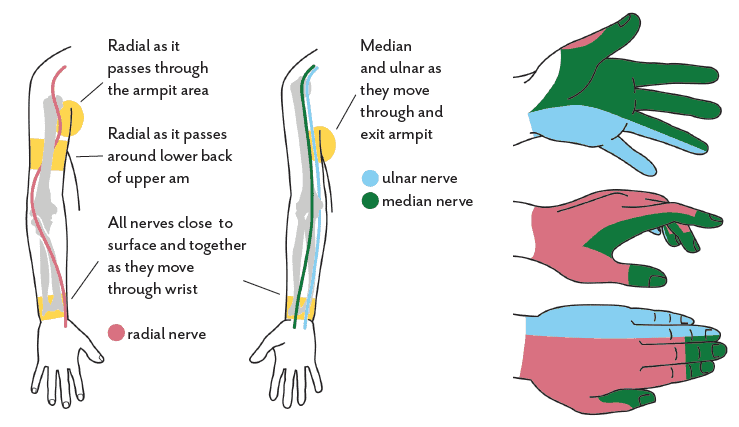
- More vulnerable locations: The radial nerve runs around the back of the upper arm to the forearm. On most people the area of greatest vulnerability lies on the outer side and back of the upper arm, near where the deltoid meets the triceps. It is also possible to compress the radial nerve at the wrist.
- Rope placement: Compression of the radial nerve is most commonly seen in ties that include a band that runs around the entire upper body, including the upper arms, especially if the arms are behind the back as in a Box Tie. With such ties, it is easy to accidently run the band right over the most vulnerable spot. Even a little pressure in such a situation can result in nerve compression. To reduce this risk, it can help to keep the rope away from the range between the lower half to lower third of the upper arm. Also, it is important to remind your partner to do their sensory and mobility tests and report issues immediately so you can adjust the position of the rope.
- Results of compression: Loss of sensation along a portion of the back of the hand, abnormal sensations that can resemble tingling or pricking, and a loss of motor control in the hand are all symptoms of radial nerve compression. “Wrist drop” is a result of radial nerve palsy — impairment of the nerve’s ability to process signals from the brain — symptoms of which include the inability to hold one’s hand in line with the arm and the inability to extend the hand and fingers.
Ulnar Nerve
- More vulnerable locations: The ulnar nerve runs along the side of the arm that is closest to the body. It is most vulnerable to external compression behind the elbow (your ‘funny bone’), under the armpit, and at the wrist.
- Rope placement: Compression of this nerve is most likely to occur when tight or loaded rope is placed close to the elbow or around the wrist.
- Results of compression: Symptoms of ulnar nerve compression can include loss of sensation in the ring finger and pinky finger, tingling or abnormal sensation in these areas, and the loss of motor control and grip strength.
Median Nerve
- More vulnerable locations: The median nerve follows a similar path as the ulnar nerve; traveling through the underarm area, alongside the body, extending through the wrist into the hand. It is most vulnerable to compression under the arms and as it moves through the wrist.
- Rope placement: Compression of the median nerve is most likely to occur due to tight or loaded rope near the wrist.
- Results of compression: Symptoms of median nerve compression can include loss of sensation in the tips of the index, middle, and ring fingers, abnormal sensation in these areas, and the inability to make a tight fist. Repetitive compression of the median nerve can result in carpal tunnel syndrome.
General – Areas Near Joints
- More vulnerable locations: The areas around the elbow, especially on the inside of the joint can be vulnerable. As is the wrist joint (where the eight carpel bones of the wrist are located).
- Rope placement: Try to avoid wrapping rope directly above or on the elbow joint. Make sure that wrist cuffs are not too tight. You should be able to slip two fingers under the ropes of the cuff. Also, it is better to place wrist cuffs a little further away from the hand, on the other side of the bump on the ulnar side of your wrist (the outside of your arm if you are looking at the back of your hands). Placing it here puts any forces from the cuff on your radius and ulnar and not on the carpel bones and the more vulnerable nerve paths through that area. Yes, as your partner moves, the cuff may naturally migrate more toward the base of the hand, but you can adjust it back if you notice this happening.