
Blood Flow and Circulation Loss
The Brain
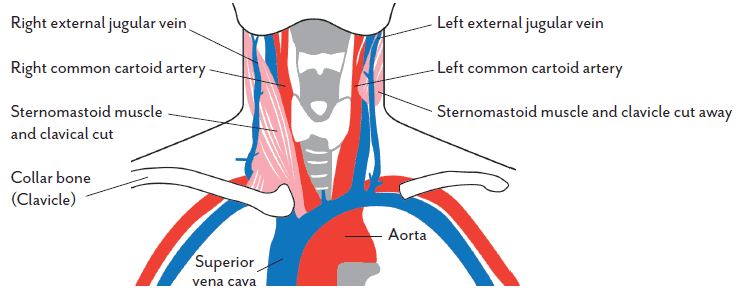
One very important (and hopefully obvious) thing: never cut off the flow of blood to the brain. Never put pressure across the front of the neck for any length of time. The carotid arteries and jugular veins that run through the front of the neck are sensitive; messing with them is highly risky.
Yes, erotic choking is something that some people do, but it is highly risky edge play. Using rope to do so adds even more danger to an already dangerous activity. There is nuance here, but choking is beyond the scope of what we will discuss here.
If you are interested in rope collars and leashes, read the Neck Rope tutorial for some important rules.
Flow of Blood Through the Front of the Neck
Elsewhere
In other parts of the body, circulation loss over a short period of time isn’t generally a major concern. However, you should keep an eye on any changes to the color of the skin. When tied in such a way that blood flow is being impacted, the skin may change color (or may not; each body is different):
- If the skin becomes darker (a shade of red, even dark red or purple): This is common in rope bondage and is not usually a concern over short periods of time (30 minutes) unless there is a complicating medical factor (like pre-existing circulation issues, e.g. diabetes, peripheral vascular disease, Raynaud’s syndrome, etc.). See “Exceptional Circumstances” below for important information on exceptions and complicating factors. Getting darker means that blood is collecting in that location because it is not able to flow out as easily as it normally does (impaired venous return).
- If the skin becomes paler: This can mean that blood is not able to flow into the area like it should (impaired arterial flow). This is a much more serious situation and should be addressed immediately, see “Exceptional Circumstances” below. This is less common, however, because arteries normally run more deeply in the body and are not compressed as easily.
While there is not normally a lot of risk if a limb is without circulation for 30 minutes or more, in the bondage world, most people want to limit risk as much as they can and will not allow blood flow to remain restricted for more than 15 to 20 minutes. They will also often take immediate steps to improve circulation by dressing ropes, moving wraps, or changing positions. In some cases, circulation loss for a period of time is unavoidable, but keep it to that reasonable time limit.
Regularly Test for Restricted Blood Flow
- Check your partner’s skin color and temperature before and during the scene. Know what is normal for your partner, so you can tell what is not normal.
- If the skin goes paler, adjust the bondage to loosen the restriction to that area.
Exceptional Circumstances that Carry Higher Risk
There are a variety of circumstances where impaired blood flow is a higher risk for a specific individual. Any condition that includes blood issues, blood clotting or circulation issues, e.g. anemia, diabetes, thrombophilia, heart issues, peripheral vascular disease, Raynaud’s syndrome, etc.
While we use the limit of 30 minutes as the normal guidance, what if things go beyond that? What if you come across a situation where an uneducated sub tried to tie themselves up, but was unable to escape and got themselves stuck in a situation where they had severely impaired blood flow for hours?
Lower Risk (typically):
- Time: Less than 30 minutes
- Medical History: No history of any blood or circulation issues
- Sensation: Slight numbness/tingling
- Discoloration: No change or mild to moderately darker
- Commonly Recommended Actions: Slowly relax the tie. The tighter it was or the longer it was on, the more slowly you need to go. Then release the rope. Preferably drink sports drink or other high sugar drink (be careful of this if they are diabetic) or water.
Take special precautions when engaging in activities with higher risk
Before you being any activity that may carry higher risk, be certain that you:
- Have confirmed that all participants fully and clearly understand the risks and are willing to accept them.
- Have plans in place for the reasonably expectable risks and that all parties know those plans.
- Have a means for emergency release (EMT shears, etc.),
- Have verified that you know how to connect with emergency services in your area (911, 112, 999, etc, depending on the country you are in), and…
- Have the means to do so (a fully charged phone with a good signal).
Moderate Risk: Any one of these … the longer or more intense, the greater the risk
- Time: More than 30 minutes, less than 4 hours*, but the longer the tie was on, the greater the risk; many consider 3 hours to be crossing into high risk.
- Medical History: Any condition that includes blood or circulation issues, e.g. anemia, diabetes, heart issues, peripheral vascular disease, Raynaud’s syndrome, etc.
- Sensation: Numbness, loss of control, cold to the touch
- Discoloration: Pale (impaired blood flow into the area), deep purple (impaired blood flow out of the area)
- Commonly Recommended Actions: Relax the tie very slowly & drink lots of fluids – ideally sports drinks/high-sugar drinks (be careful if they are diabetic), otherwise water. Fluids help the liver remove toxins from the blood; a blocked vascular pathway will accumulate waste products (toxins) over time. By drinking water and releasing the tie slowly, you cushion the impact on your system and liver, hopefully reducing the risk of complications. As always, this is not medical advice, I am not a doctor; if unsure, contact a licensed medical professional.
High Risk: Any one the below or two or more items in “More Risk” above
- Time: 4 hours* or more (although some people use a lower threshold, 3 hours, for example)
- Medical History: More than one condition that includes blood or circulation issues. Or any condition that creates increased risk of forming blood clots in the veins, thrombophilia, for example. << We do not recommend tight binding a person that has a history of such conditions.
- Sensation: No sensation, loss of control, cold or hot to the touch
- Discoloration: Extremely pale (there is a risk of severe ischemia, insufficient blood flow into the area, which can cause serious problems), very deep purple or black (it may be that there are blood clots forming)
- Commonly Recommended Actions:Do not attempt to deal with a high-risk situation on your own. SEEK EMERGENCY MEDICAL ATTENTION IMMEDIATELY.CRITICAL: DO NOT UNTIE THEM. Let the medicinal professionals do it. A deep purple or black limb, for example, may have blood clots in it. If those clots are released into the regular blood stream, they may cause stroke, heart attack, other forms of thrombosis, or death.
Play purposely involving circulation – “The Guatemalan”
There are types of play that intentionally reduce or stop blood flow.
One well-known type is “The Guatemalan” a technique that can be applied to the calf, thigh, entire leg, folded leg or both legs together. It involves wrapping the target area extremely tightly (taking care to avoid nerves and joints). This technique entirely violates the general rule that one should always be able to slip 1-2 fingers under rope, but in a way that does not normally pose significant added risk for most people, with the exception of those with higher risk conditions (discussed above). The Guatemalan and related techniques, purposefully trap blood in the muscle. Lactic acid quickly begins building. The skin of the affected area becomes hyper sensitive to touch or other sensation. Even a gentle caning can be excruciating, as can lifting them by that rope or making them move or kneel while tied. This can be incredibly intense and is something that should only be attempted after detailed and fully informed negotiation, and after training with an experienced mentor or instructor. The bottom is not left in that condition long (no more than 15 minutes, often much shorter). When released the rope is removed slowly to control the pressure change experienced by the rest of the body. For some, that release itself can also be intense; for some, almost orgasmic.
This is one example of “Sadistic Rope”. (We do not yet have any tutorials on this subject on TheDuchy, but do plan to add some.)