
Overhand Knots
By Lazarus Redmayne
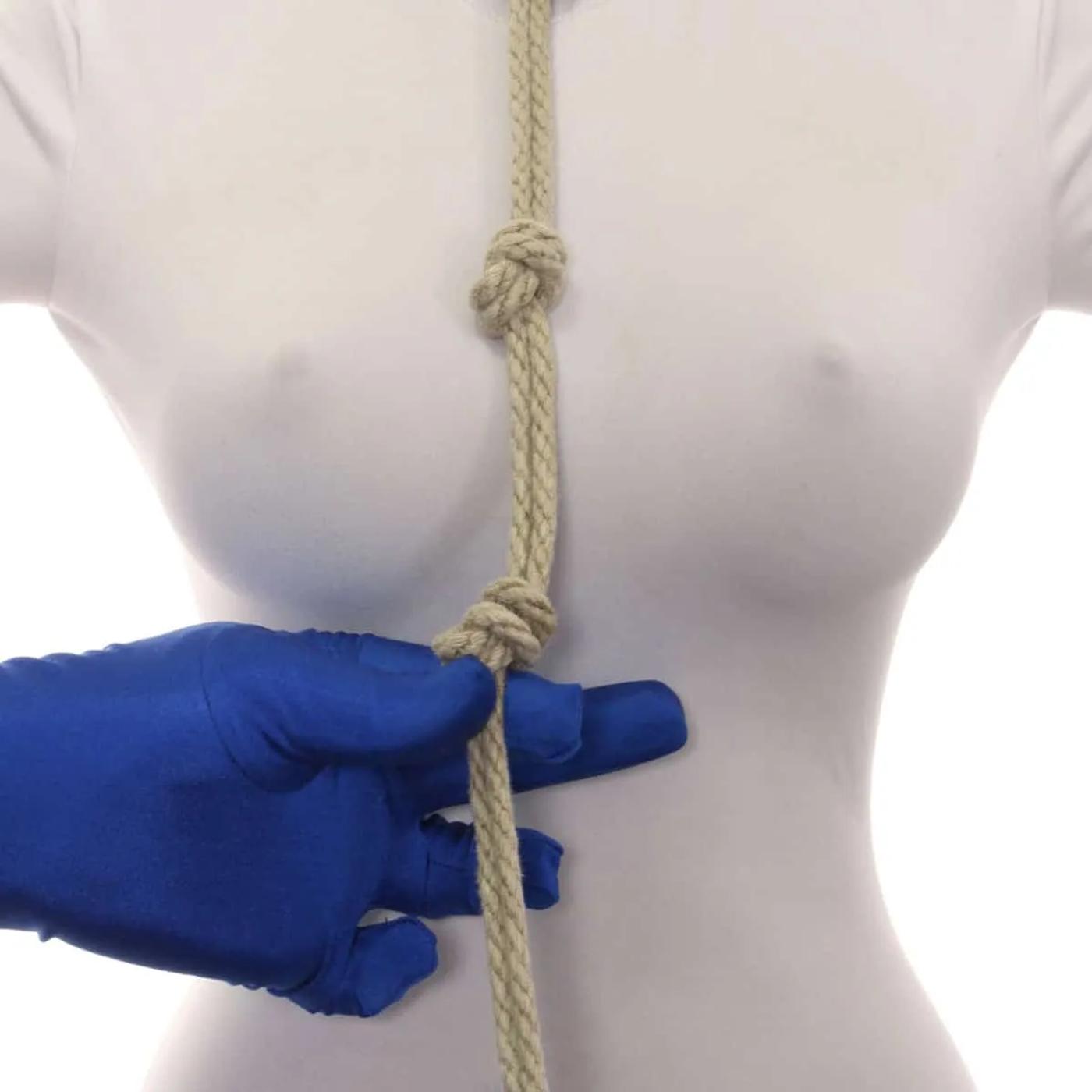
This simple knot has many uses:
- Finishing the end of a rope so it does not fray.
- Temporarily marking the bight of your rope before you put it down. (See below)
- As a component of a harness to hold two ropes together in one place before they are separated in another. (See below and the Hishi Karada tutorial)
- As a stop knot to keep a rope from slipping through the end of a pulley.
Because of its tendency to bind when put under tension and therefore be difficult to untie, it is typically only used in areas where it is intended to be permanent or in situations where it will not be subjected to a great deal of tension.
Risk Management and Safety
This knot should never be used in situations where it might be holding the weight of a human (such as if you are doing a suspension). An overhand reduces the amount of tension a rope can withstand (its strength) by 50%.
Video
Core Overhand Knot Basics - Pictures & Text
Basic Overhand Knot
This is often use at the end of rope to keep it from fraying. (See Rope Ends for more options.)
Pros - Finishing a rope this way is that the lump formed by such a knot gives greater control over the ends when tucking them under other lines at the finish of a tie.
Cons - The down side of this approach is that there is a lump at the end of your lines which puts a bit of a speed bump in the way when pulling tails through a tight area.
Take the end of a rope
Form a loop and tuck the end through the loop as shown
Tighten. Done.
Double Overhand Knot
For the Double Overhand, take the end of a rope, form a loop and run the end through that loop twice as shown
When tightening this one, guide the outer parts of the loops down over the center as it tightens
Thus
When it is tightened, you get this, which is one of the easiest and fastest rope ending techniques out there…
…but it does end your rope with a bump, which can be good or bad depending on your preferences.
Overhand Knot on a Bight
You can also form an overhand on a bight
Just loop the bight…
…and tuck it through the new loop
Thus
...no particular mystery here :)
Practical method for tying when rigging, using two hands - Pictures & Text
When used in bondage, it is often helpful to make overhand knots in a consistent manner so that you get consistent look. For example, you may wish to put a series of overhand knots down the front of your partner as part of several different types of harnesses
I feel compelled to point out here that one general rule for beginners is “do not put rope around the neck” which I have done here. That rule is the simple version for beginners. The *real* rules are “don’t put collapsing knots around the neck” and “don’t put pressure across the front of the neck”. In practice, a rope leash like this is not a particularly unusual thing, as it does not violate either of those two rules.
Place the fingers of your left hand behind the rope at the point where you want the overhand knot to be
With your other hand, bring the tail up behind your two fingers…
…And then to the front, crossing over the standing line
Spread the two fingers of your left hand just a little bit to allow your right forefinger through that loop to hook the tail
Use that finger to draw the tail through the loop
Like this
Pull the tail all the way through
Using your left fingers as a stopping point to position the knot as it is being tightened, pull the tail with your right hand to tighten.
Done. Let’s do it again using exactly the same technique so you can see how doing it consistently leads to nice symmetry
…
…
…
…
…
…
There you are, two knots created the same way, lying the same way, nicely evenly spaced
Practical method for tying when rigging, using one hand - Pictures & Text
There are times when you need to tie an overhand knot with a single hand. I am going to use my left hand to hold this a rope under a little bit of tension so it’s easier to see what I am doing, but it is not necessary
Using your dominant hand, run two fingers behind the tail
Twists those fingers around that tail as shown…
All the way around…
…until they are in a position where they can grab the tail
Grab the tail
And pull it through the loop
Tighten.
If you’re doing this with one hand, it’s a little difficult to get that knot positioned at a precise point, but with practice you can get a relatively close to your intended location
Done
Using the Overhand Knot to mark your bight - Pictures & Text
An overhand knot can be very helpful to temporarily mark your bight!
Sometimes it is necessary to put down a rope in the middle of rigging and you don’t want to lose your bight. For example, when you are untying, you pull off one rope and immediately move on to the next rope. You don’t take the time to neatly coil your rope right then, you keep untying. And then move on to after care. You or your partner come back later to coil your ropes.
Place the fingers of your non-dominant hand behind the rope a short distance from your bight
With your other hand, bring the tail up behind your two fingers and back to the front, crossing over the standing line
Spread the two fingers inside the loop just a little bit to allow your other forefinger through that loop to hook the tail
Use that finger to draw a small bit of the tail through the loop
Tighten
This can now be set aside or dropped until needed
When needed again...
Pick up the rope by the bight
Grab the tail with your other hand
Pull firmly
The knot will come undone
You are ready to go!
Comments
Loading comments...
Sign in to leave a comment.