
Rope Ends
By Lazarus Redmayne
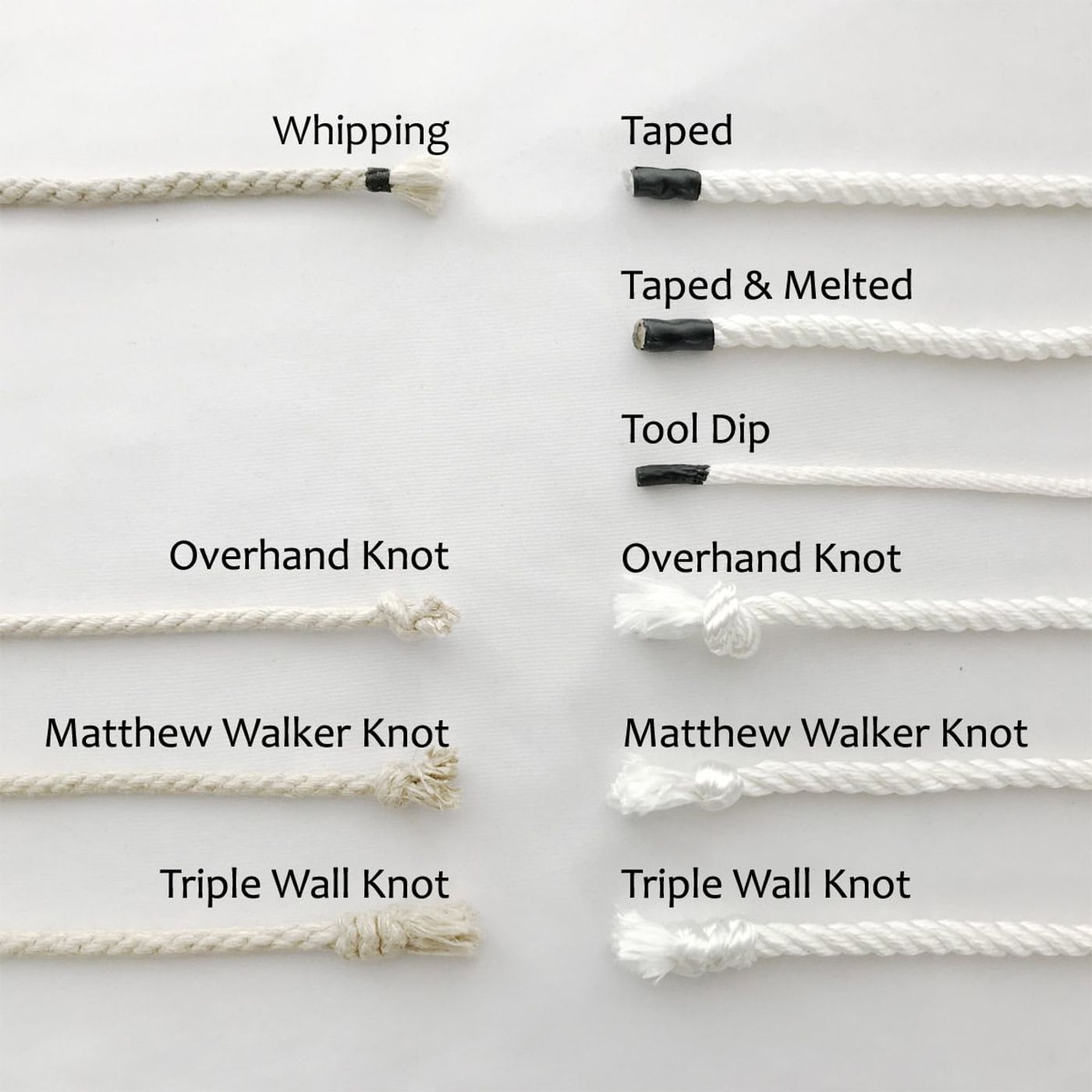
There are many ways to finish off the ends of your rope, from the simple and fast to the decorative and involved. This page goes over a few of the popular ways. There are *many* more...
Some people prefer smooth ends with no knots so they can choose on the fly exactly what will happen at the ends without having to deal with that extra bulk, but many prefer knots at the end as it makes adding rope easier...
As with everything, there is no "one true way", if there is something you have come across that works well or if there is a tip I should add to any of these, drop me a line and we will keep growing this collection...
Simple Approaches - Taped Ends or the Overhand Knot
While these techniques are simple, there are still a few tips and tricks for doing them. I also talk about why you might want to choose these approaches over others that are more decorative and involved... To sum up, these are faster, so you don't get so invested in your rope and can undo them to adjust the lays of your rope in the future if needed.
Melting Paracord or Nylon Rope
With synthetic fibers, you can certainly use the simple approaches above, but you can also choose to melt your ends. Here are some tips on that...
The Wall Knot, Double Wall Knot and Triple Wall Knot - Decorative
Some people like more decorative approaches. While these do take a little longer, they look great!
The Matthew Walker Knot for 3-Stranded Rope
This is a very stable decorative knot, slim and attractive and easy to tie once you get the hang of it. It is really just a simple modification of the Wall Knot
The Matthew Walker Knot for 3,4,5,6+ Strands - Colored Paracord Version
This video shows you the 3-strand (also shown above), then goes on to demonstrate the multi-strand version of the knot that works well for 4-strands, 5-strands, and 6-strands. Hopefully, the multiple demonstrations of greater and greater numbers of strands will help you master this very cool knot.
In this video, I am using 550 paracord in multiple colors instead of my usual hemp. This makes it much easier to see what is happening and how the various cords fall.
Tool Dip
While this approach isn't for everyone, some appreciate the grip of the rubberized coating and, for some, even color coding their ropes with different colored dips...
Whipping
I rarely use this approach myself as it takes more time than I like to invest, but it is still quite popular and is featured on rope from my affiliate, Twisted Monk. Check them out for great rope, purpose-made for bondage!
If you want to learn how to do this yourself, check out Sailmaker's Whipping from Animated Knots.
Comments
Loading comments...
Sign in to leave a comment.