
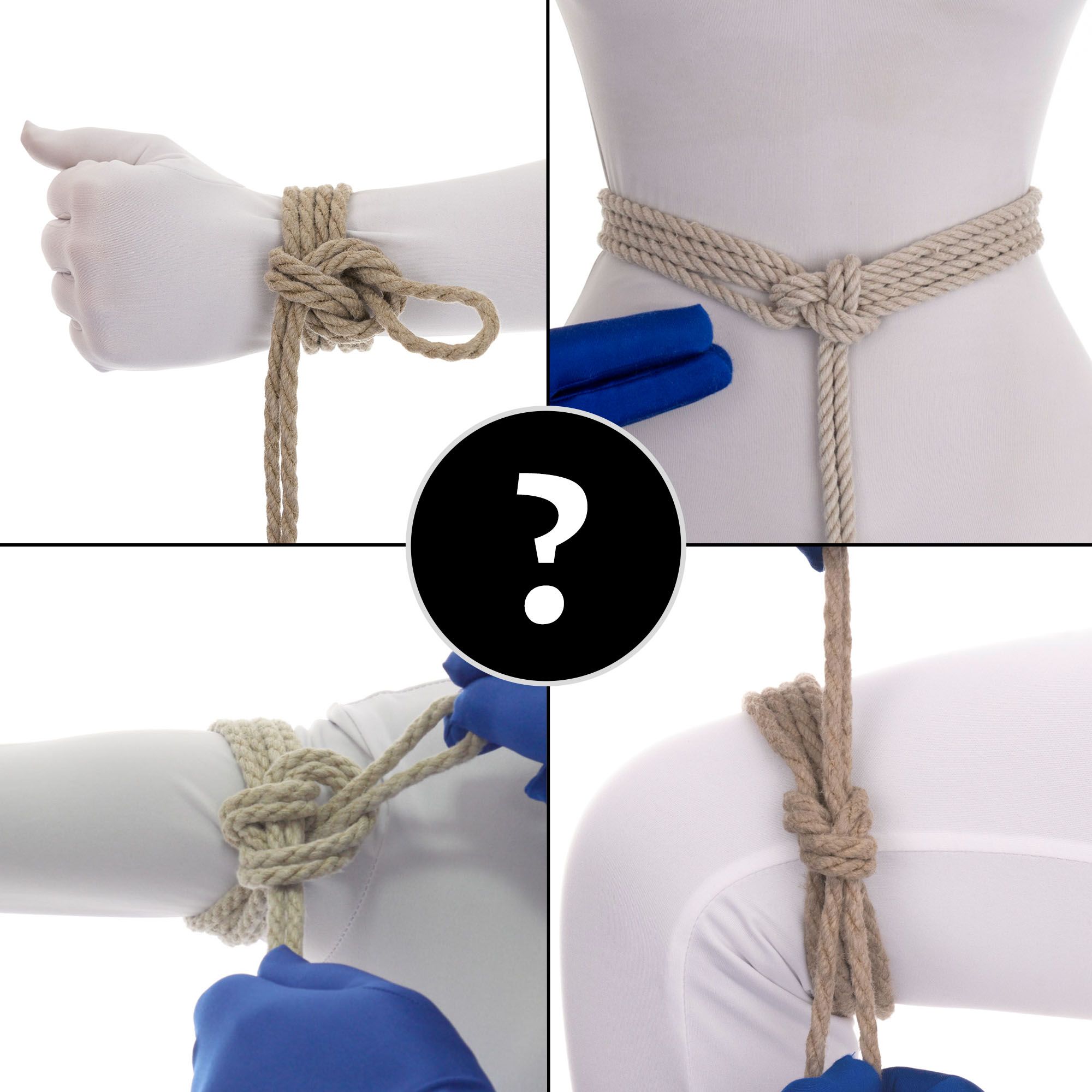
Which do I use!? Choosing a Single Column Tie
Which do I use!? Somerville Bowline? Lark's Head Double Column? Classic Single Column? Burlington Bowline? Fast Bowline? ... Choosing a Single Column Tie
- What is a Single Column?
- What is a Single Column Tie?
- What is a rope bondage cuff?
- Are Single Column Ties and rope cuffs the same thing?
- Why is the Single Column Tie one of the first rope bondage ties people learn?
- What makes a Single Column Tie non-collapsing?
- What are the most common types of Single Column Ties?
- What is the difference between a forward-tension and reverse-tension Single Column Tie?
- What is a Somerville Bowline?
- What is a Lark’s Head Single Column Tie?
- What is a Square Knot Single Column Tie?
- What is an Inline Single Column Tie?
- What is a quick-release Single Column Tie?
- Which Single Column Tie is best for beginners?
- Which Single Column Tie is most secure?
For answers to these related questions, see Getting Started and Foundations of Rope Bondage:
- What is the safest way to tie a rope cuff?
- How do I tie a basic Single Column Tie?
- How do I tie wrists with rope safely?
- How do I tie ankles with rope safely?
- How tight should a rope cuff be?
- How do I know if a Single Column Tie is too tight?
- What makes a Single Column Tie non-collapsing?
- Why should a rope bondage cuff not cinch down?
- What are the most common types of Single Column Ties?
- Which Single Column Tie is best for beginners?
- Which Single Column Tie is most secure?
- Which Single Column Tie is easiest to untie?
- Can a Single Column Tie be used for suspension?
- What kind of rope should I use for rope bondage cuffs?
- How much rope do I need for a Single Column Tie?
- Should I use one wrap, two wraps, or three wraps?
- Where should rope cuffs be placed on the body?
- What body parts should I avoid tying?
- What are the safety risks of tying wrists or ankles?
- How do I avoid nerve compression in rope bondage cuffs?
- How do I check circulation when someone is tied?
- What should I do if someone’s hand goes numb in rope bondage?
- What mistakes do beginners make with Single Column Ties?
- How do I practice Single Column Ties by myself?
- How do I tie a Single Column Tie on a partner?
- How do I untie a Single Column Tie quickly?
- Why does my Single Column Tie fall apart?
- Why does my rope cuff twist, bunch, or tighten?
- What should I learn after Single Column Ties?
Popular Rope Single Columns (Cuffs, Bands & Straps) and When to Use Them
A Single Column tie (often abbreviated “SC” or “SCT”) is one of the fundamental building blocks of rope bondage. A SC is a non-collapsing cuff, belt, band, or anchor around one "column": a wrist, ankle, thigh, waist, chest, furniture rail, or another object. A good SC should distribute pressure evenly across multiple strands of rope, and be non-collapsing, that is, the knot holds its shape when the tail is loaded and the strands of the cuff to do not tighten when the person in rope moves.
There are many different types of Single Columns. There is no single version that is best in all situations. Different approaches solve different problems. Some are fast. Some are easy to inspect. Some are especially stable. Some are useful when the rope is already attached to something else. Some can be released quickly.In this article, we will review a few of the most popular and discuss where each shines … and where it struggles.The useful question is not "Which tie is best?" but "What job does this cuff need to do?"
Before comparing techniques, a safety note: wrists, ankles, and upper arms all contain vulnerable nerve pathways. A cuff that is technically non-collapsing can still be unsafe if it is too tight, loaded in a bad direction, placed over a nerve path, left on too long, or forces the body into a position that stresses the bottom to greatly or for too long a time. Check out Risks When Using Rope for more on this important topic. Use appropriate slack, communicate, monitor sensation and motor function, keep cutting tools accessible, and avoid treating any online article as a substitute for hands-on instruction.
TL;DR:
My top 2 recommendations for beginners (and what I personally use most often in practice):
- Choose Lark's Head Single Column when you want a clean, secure reverse-tension cuff and have time for the tail pulls. It is also excellent for learning and teaching core mechanics.
- Choose Somerville Bowline when you want the most reliable all-around answer. It is a strong default for many riggers because it balances speed, stability, and accessibility.
Other popular SCTs, suitable for specific situations, needs or cases:
- Choose Burlington Bowline when you want a fast, stable cuff with good inline adaptability, especially if it fits your hand and movement style better than the Somerville.
- Choose Square Knot Single Column when speed, tradition, and compactness matter, but only when you know how to orient and reinforce it.
- Choose the Fast Bowline when you are trying to match the visual aesthetic of the Lark’s Head Single Column or when your rope style is built around that cuff and you understand its limits.
- Choose the Burlington Bowline, Hojo Cuff or Captured Overhand Cuff when the rope is already attached and you need to add a cuff at some downstream point in the rope.
Most riggers benefit from mastering three go-to single columns: one forward-tension workhorse for speed, one reverse-tension for security and appearance, and one inline cuff.
- For many people, that set might be Somerville Bowline, Lark's Head Single Column, and Captured Overhand or Inline Burlington.
- Another rigger might prefer the Square Knot Single Column instead of the Somerville, particularly if working in a more traditional aesthetic, or the or Burlington Bowline if they find it fits their style better.
- The point is not to collect a large variety of Single Columns; it to master a few solid options and understand them so you pick the right one for the job!
To understand why I recommend these things, continue...Most popular single column ties fall into two broad families.
Reverse-tension single columns have the tail reverse direction at some point early on while being tied. The Lark’s Head Single Column is a classic example of this type. It starts with a Lark’s Head, reversing the direction of the rope after going through the primary bight, then adding more wraps to form the cuff. Reverse tension cuffs often give the rigger control earlier in the tying process, tend to be visually clean and mechanically secure, and can be forgiving of minor mistakes. Their main drawback is speed: they usually require one or more tail pulls, which makes them slower and less convenient, especially when the rope is long.
Forward-tension single columns are tied without that early tail pull/reversal. Many can be tied or untied without ever requiring a tail pull. They are often fast, efficient, and convenient, and (because they do not require a tail pull) can often be tied in-line, meaning that they can be added in the middle of the rope when one end has already been tied to something.
Popular Single Column Ties
What each is good for, why a rigger might choose it and tradeoffs.The Lark's Head Single Column is a classic reverse-tension cuff built from a Lark's Head, some wraps and a lock-off, usually a Half Hitch. This is one of the most fundamental ties in rope bondage because it teaches building blocks used everywhere: lark's heads, direction changes, cuff-width, tension control and half-hitch lock-offs.
Why riggers choose it:
- It is a strong learning tool for rope handling fundamentals.
- It is secure, mechanically intuitive and quite forgiving of minor errors.
- There are a variety of ways to do the lock off, depending on your needs:
- Reverse Tension, good if you want the tail to move perpendicularly away from the column, faster (only one tail pull)
- Forward Tension, good if you want the tail to move parallel with the column, a very attractive flat knot, but requires two tail pulls.
- It allows for early control of the bottom because the reverse-tension structure can cinch down to grip the bottom and then be adjusted to a more appropriate level of tightness before final lock-off.
- It is less bulky and often more visually elegant than some forward-tension cuffs.
Where it shines:
This is a strong choice for torso, thigh, waist, and other larger padded areas, and it is a useful foundational tie for beginners to understand how to convert a collapsing loop (a Lark's Head) into non-collapsing loop by using a Half Hitch. It also appears as the structural basis for many straps, belts, and harness starts.
Tradeoffs:
- It is slower than forward-tension ties, especially with long ropes. This is because usually requires pulling the rope tail through the knot two or three times.
- It cannot be untied without freeing the tail (untying the rest of the harness first). This is good for security, but not great for situations where you may want to be able to quickly release a tie (emergency release). For a cuff that can be untied without untying the entire harness, try the Somerville.
- This approach has one failure mode: If person creates the Half Hitch lock off further from the node, then tries to tighten the HH solely by pulling the tail without first making sure that HH is firmly seated into the node, the SC can become malformed and can collapse. This is not an issue if you first seat the HH properly, as is shown in the tutorial. **Node before Load**
Best fit:
This is a very popular technique. Many harnesses start with one of these. Use the Lark's Head Single Column when you want a secure, attractive, low-bulk reverse-tension cuff or band of rope and do not mind the extra tail pulls. It is also a good teaching tie, because it makes the mechanics of non-collapsing cuffs very visible.The Somerville Bowline is one of the most widely-used modern single column ties. Topologist introduced it to the BDSM rope community in 2010, describing it as an attempt to combine the speed of the Portuguese Bowline with the compactness of the French Bowline. It spread quickly and is now one of the most widely taught ties in rope bondage, that is not of Japanese origin.
Why riggers choose it:
- It is extremely fast once learned (it is not uncommon to get down to 7-10 seconds).
- Tied properly, it is extremely stable.
- It does not require tail pulls.
- It can be tied when the other end of the rope is already attached to something.
- It can be untied from either end when not heavily loaded.
- It is forgiving compared with many fast cuffs; the tensions on individual wraps can be adjusted after it is tied.
- The slipped variant can be a valuable quick-release safety tool.
Where it shines:
The Somerville Bowline is an excellent general workhorse. While it can be tied in-line, it is most commonly used at the beginning of a rope, especially when tying a limb that will become the starting point for a larger structure. It is a common choice for wrists in gote shibari or box-tie work, especially when slipped as that allows the rigger to quickly release the wrists without dismantling the entire chest harness. It is often described as “bomb-proof”, meaning that – properly tied – it is extremely stable and will not collapse under load. It is useful for any application where a rigger wants a reliable cuff that can be tied quickly.
Tradeoffs:
- It is a little bulkier than some alternatives.
- It can be difficult or nearly impossible to untie under significant tension unless it was intentionally tied as a slipped variant.
Personal Note from Lazarus:
If I am not using a Lark’s Head Double Column, I am probably using the Somerville Bowline.The Square Knot Single Column is what many people mean when they simply say "single column", particularly in a classical shibari context. It is based in the Square Knot (the same knot you use to tie your shoes), thus it is fast, intuitive, and historically widespread.
Why riggers choose it:
- It is extremely fast.
- It is intuitive for most, and the basic version is easy to teach .
- It lets the rigger set cuff tension precisely before finishing.
- It is compact.
- It can be rapidly untied.
- It is embedded in many older/classical teaching lineages.
Where it shines:
This style is fast and common in traditional patterns where the cuff is not expected to take heavy, changing, or poorly aligned load. Its speed makes it attractive for starts where the rigger wants to establish position quickly and continue into the rest of the tie.
Tradeoffs:
This is the family that most often needs explicit caution. Square knots and related half-knot/Overhand Knot stacks can capsize if loaded the wrong direction or being subjected to variable load without being reinforced. This is particularly true when using synthetic fibers that often have less “tooth” (less friction) than traditional, natural fiber ropes. If the knot becomes malformed, the cuff can collapse under load; therefore, it is common to reinforce the core knot with an additional half knot, Overhand Knot or Half Hitch when using these techniques
Best fit:
Use a Square Knot Single Column only when you understand it and its limits: Its directionality, how to load it, how to reinforce it, etc. It can be beautiful and efficient in experienced hands, but it is not the cuff to choose when you need maximum fault tolerance, are working with slippery rope (many synthetics fall into this category), or may have uncertain load direction.
Personal Note from Lazarus:
If personally don’t use this one often and I don’t spend time on it in my in-person Foundations of Rope Bondage classes. I prefer to start people with techniques that are more reliable and forgiving of minor errors.While many instructors are have standardized on either “Single Column” or “Square Knot Single Column” for this technique, you will also find tutorials out there giving several other names. Some communities might call this the "Boola-Boola" or "Yuki Single Column”, and it is not always consistent. Sometimes they will use one of these terms to differentiate between various ways the second half of the knot can be done, for example, closing it using a Granny Knot or a Half Hitch (…which tightens into a Square Knot or Granny Knot), instead of focusing specifically on the Square Knot structure. As more and more people are creating tutorials, some are working to get more precise and descriptive in the terms they use, so we will likely see more specificity as time goes on…The Fast Bowline family was popularized into the rope world by the great British rope educator, WykD Dave, although others used it before then. It is a very fast forward-tension cuff, sometimes also referred to as a reverse French bowline or Eskimo Bowline and can be another great way to start a box tie.
Why riggers choose it:
- It is very fast.
- It has a simple hand pattern after practice.
- It is easy to untie compared with more locked-down options.
- It is work well as the starting point (wrists) for box-ties / gote shibari / TKs.
- It can be made quick-release if slipped.
- It also has a similar appearance to a Lark’s Head Single Column when locked of with a forward-tension Half Hitch, so can be a good companion if you need a forward-tension Single Column to pair with your Lark’s Head Single Column (a reverse-tension technique)
Where it shines:
This tie is attractive when speed and flow matter, especially for riggers who use it as a familiar start for behind-the-back wrist positions. It can be appropriate where the cuff itself is not the primary load-bearing safety element and where the rigger understands how the rest of the structure will control load.
Tradeoffs:
- It is more stable than square/granny styles, but can still capsize under heavy load or with slippery rope.
- It is directional, it is quite stable if loaded one direction, but may tighten or fail differently if loaded the other.
Best fit:
Use the Fast Bowline when speed, tradition, or a known box-tie workflow call for it, and when you understand the load direction limitation and how to reinforce it. Avoid using it in situations with uncertain loading.The Burlington Boswline was developed by Tracker of Innovative Fiber Arts of Vermont riffing off of the work of Topologist’s Somerville Bowline. It is also a very fast and stable single column. The inline variation is particularly useful, allowing you to add another cuff in the middle of the rope, when one end of the rope is already anchored (perhaps is a cuff around the other wrist).
Why riggers choose it:
- It is fast once practiced.
- It is stable and non-collapsing.
- It has slipped and inline variants.
- It fault tolerant and direction-of-pull friendly.
- It adapts well to double-column and inline applications.
Where it shines:
The Burlington Bowline is particularly useful when teaching a robust first single column to students who may struggle with the Somerville Bowline's loop formation or the Square Knot Single Column's directionality. The inline Burlington variation is useful for bondage belts, handcuff-style arrangements, and cases where differences in flexibility can be smoothly dealt with by placing individual cuffs further apart instead of trying for a Double Column
Tradeoffs:
It is less universally recognized than the Somerville Bowline, Lark's Head, or Square Knot Single Column, so a rigger may need to explain or demonstrate it more often in shared learning spaces. Its speed also depends on practice; until the hand pattern is learned, it can feel less obvious than the techniques above.
Best fit:
Use the Burlington Bowline when you want a stable, fast cuff with strong inline options. It is a good candidate for a rigger's primary "workhorse" cuff if they like its handling.A Hojo Cuff is an inline single-column tie; a quick way to add a cuff in the middle of your rope. Instead of starting at the end of the rope, it lets the rigger add a cuff in the middle of an already active line. That makes it useful in exactly the situations where many other single columns become awkward: when one end is already attached elsewhere, when the rope is already under tension, or when the cuff needs to be added at a very specific point in a larger pattern.
Why riggers choose it:
- They are fast.
- They work inline, in the middle of an active rope.
- They can be tied while managing existing tension.
- They have strong historical and stylistic roots in hojōjutsu-inspired rope.
Where they shine:
Hojo cuffs are especially useful in ties like mayfly- or tengu-style chest/arm harnesses, some strappado variations, and other structures where the rope is already doing something before it reaches the next thing to bind. In those situations, a hojo cuff can feel elegant and efficient because it lets the rigger “catch” a wrist, arm, thigh, or ankle without breaking flow. They are popular in more traditional styles.
Tradeoffs:
This is not the most conservative inline cuff. The basic hojo cuff is not stable on the incoming line. If tension is put on the cuff unevenly, it can tighten or collapse. The mitigation for this is to use stabilized variations, add extra finishing half hitches, or choose a more secure inline option such as a Inline Burlington Bowline or Captured Overhand Cuff when load direction may vary.
Best fit:
Use a hojo cuff when the main problem is placement and flow: “I need to add a cuff here, in the middle of this rope, and I know how the tension will behave.” It is a valuable tool for experienced riggers who understand its directional limits. If the cuff may see uneven, shifting, or poorly controlled load, a more stable inline cuff is usually the better choice.
Captured Overhand Cuff
The Captured Overhand Cuff is another useful addition because it solves a different problem: adding a cuff to a rope that is already attached to something else. This is another great development by Topologist of Crash Restraint fame, building on some earlier work by Tracker.
Why riggers choose it:
- It is designed for inline work.
- It can add a limb after the rope is already in use.
- It is stable under varied loading compared with simpler inline cuffs.
- It is useful for ankles, wrists, thighs, and positional tie-ins.
Where it shines:
Use it when the cuff is not the first thing in the rope. Examples include tying an ankle to an existing chest line, adding a wrist into an already established structure, or building leg-loop and gunslinger-style arrangements where the cuff must be placed at a specific point on an active line.
Tradeoffs:
It is more fiddly than very simple cuffs and is not as common as the big beginner single columns. It is best learned after the rigger already understands basic cuff mechanics.
Best fit:
Use the Captured Overhand Cuff when "I need a safe cuff here, in the middle of what is already happening" is the main problem.
Assorted other Single Columns
I don’t yet have tutorials of these on TheDuchy. But here are a few other Single Column techniques that have useful features, depending on what you are trying to achieve and/or the style you are tying.
- The Kaa Cuff is a very fast, self-tensioning cuff from hojōjutsu roots, great for takedown play.
- The Fynch Cuff (a.k.a Hitomusubi), also of hojōjutsu roots is an alternative way to lock off a cuff that begins the same way as a Square Knot Single Column. While not as well known (because it take a little more time), it is much more stable than then the standard approach.
Quick Comparison
Tie Best for Main advantage Main caution Lark's Head Single Column Secure low-bulk cuffs, teaching fundamentals, straps/belts Very secure and clean Slower because of tail pulls; tail must be freed to untie Somerville Bowline General-purpose limb cuffs, box tie starts, larger structures, suspension Fast, stable, no tail pulls, untie from either end Hard to untie under load unless slipped Burlington Bowline Workhorse modern cuff, inline variants, teaching stability Fast, stable, adaptable Less universally known Square Knot Single Column Classical fast starts, low-load floorwork Very fast and compact Directional; can capsize or collapse if misloaded WykD/Fast Bowline Fast gote/box-tie starts Very quick and easy to flow into a tie Not the most conservative choice for heavy or uncertain loading