
Somerville Bowline
By Lazarus Redmayne
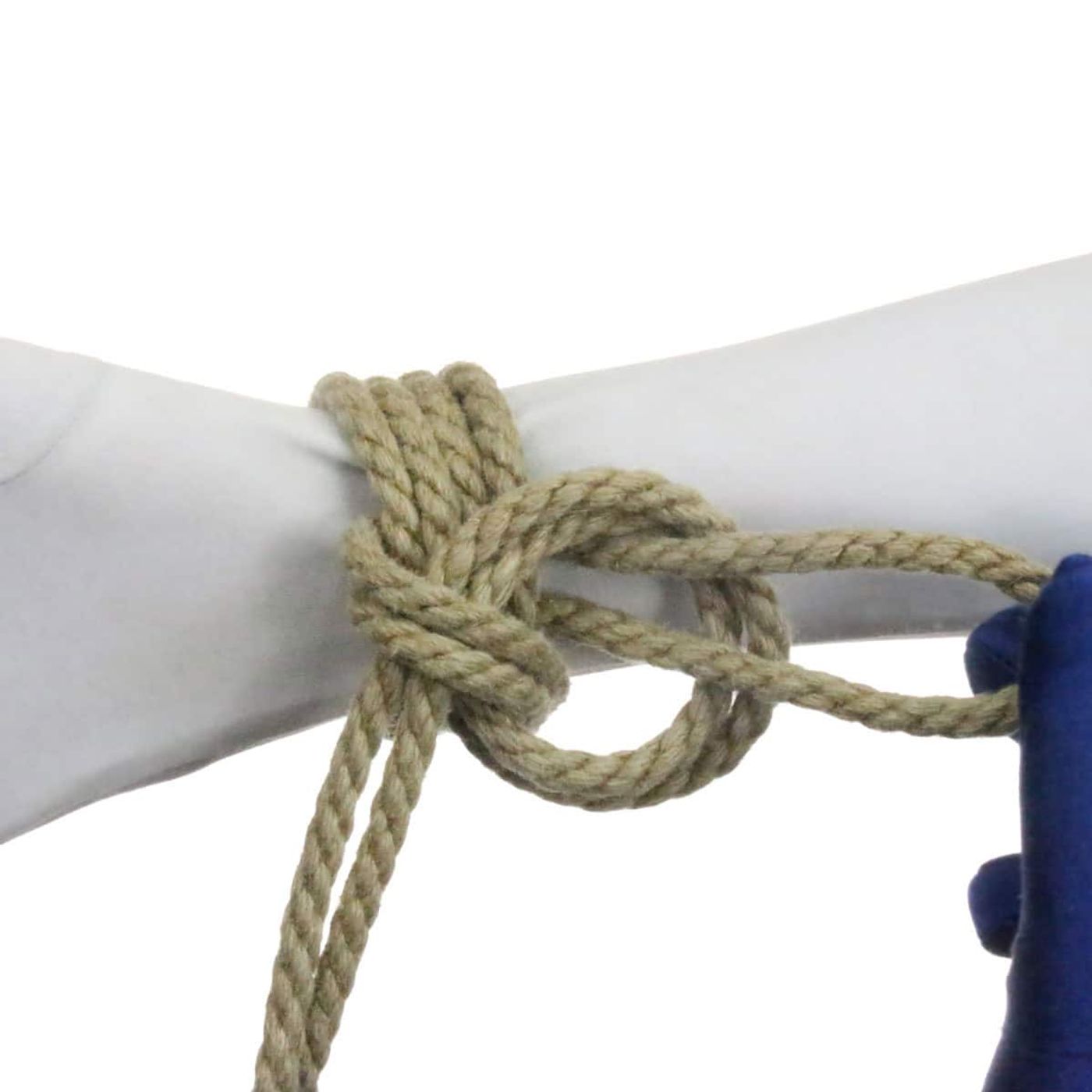
This is my favorite forward-tension single-column tie. It can be applied when the trailing end is already attached to something! It requires no tail pulls.
This amazingly useful tie is a variation on the Carrick Bend that also incorporates elements of the French Bowline. It was discovered and introduced to the BDSM community by Topologist in 2009 and quickly became one of the most widely-taught ties not of Japanese origin.
Pros: Can be used to tie up something when the other end of the rope is already tied to something. It can also be untied from either end. That said, this knot is very stable under tension, so if you anticipate needing to untie it when under tension (such as in a Gote Shibari), be sure to "slip" the bight so you can pull it free.
Cons: It is a touch more bulky than some options, but that's pretty minor...
Rope Needed
For this demo, I used one 10' (~3m) piece of Natural 6mm provided by my affiliate Twisted Monk. Check them out for some amazing hemp rope!
Video
Video Contents:
- Somerville Bowline - Right-Handed (0:08)
- Slipped Somerville Bowline (A very cool quick-release safety tool!) (2:29)
- Somerville Bowline - Left-Handed (4:29)
Somerville Bowline Core Technique - Quick Overview
Here is a simple view of how a Somerville Bowline is structured. For a more procedural version of how to tie this, along with a bit more detail on each step, check out the "Detailed" version below.
Place the bight against the thing to be tied, leaving about 3-5 inches free
Wrap the lead around 2 or 3 times
Hold the bight away from the target and loop the tail around it
Note that with this new loop you have formed a sort of cross
Place the bight end across the top of this cross
Reach under the cuff and grab the bight
Pull the bight underneath the cuff
Now run the bight through the loop by...
...reaching through the loop, grabbing the bight...
...and pulling it through. Tighten the knot first by tugging the bight, then...
...by tugging the tail
Once the knot is well formed, tighten more fully
Done!
Somerville Bowline Core Technique - Detailed Version
You can create a Single Column on anything. I’m choosing the wrist in this case. It is easier to learn this tie when you are perpendicular to the column you are tying. With practice, this can be tied in just a few seconds!
This example shows the tie being done with two wraps (for a total of four strands), but you can do three wraps as well (for a total of six strands), which spreads the force over a larger area. Using that extra wrap is particularly helpful when putting two wrists through one Single Column like you would in a Box Tie.
Begin with your rope folded in half. Grab the bight with your dominant hand. This will be your active hand. With your other hand — your guiding hand — grab the rope a few inches away from the bight. The guiding hand will remain mostly static while you are doing the wraps, simply helping to keep them in position and guide them as they slide. The other hand will be the active hand and do most of the moving of the rope.
With the active hand, lay the rope on top of the column you are tying, positioning the bight going away from you. Then reach under the column and grab the bight.
Pull the bight under and back to the other hand to make the first wrap. Pull out enough of the bight so there is sufficient rope to make a second wrap.
Having your finger inside the cuff establishes a safe space between the skin and the ropes so you do not make the cuff too tight. It also helps keep the strands parallel and at the same tension while you are doing the wraps. If you need more rope, hold the bight in place, then slide your other hand (the one under the cuff) back down, clip on to the cuff again, and….
…then grip the rope of the cuff and slide it back up and around again, “ratcheting” the rope around to build the cuff.
If you need more, slide your guiding hand back down…
…rotate some more. This way you can feed more rope around to get a better bight. Do this until you have a completed cuff with 4-6 inches of bight.
Make sure the strands are all close together, are parallel, have no twists, and are of even tension, then, using your active hand, lay the bight across the top of the wraps of the cuffs.
With your guiding hand, pinch the rope in the crook of your forefinger. You want to grip it with just your forefinger, so the thumb is free to help with the next steps. Move your active hand from the bight to the tail.
You are going to wrap the tail around the bight. To begin this, bring the tail around your forefinger. At the same time, slide your thumb under the bight.
Using the thumb of your guiding hand, flip the bight down toward the tail.
Continue bringing the tail around so that it is on the other side of the bight.
Pull your thumb out of the way…
…then move your thumb below the bight…
…and flip it to the other side of the tail.
The next thing we need to do is run the bight underneath all the strands of the cuff and then up through the loop you just completed. (here).
You can do this in a single move by putting your finger through the loop and underneath the strands of the cuff, like this.
Hook the bight with that finger.
Draw the bight underneath the strands of the cuff and through that loop.
Keep tension on that bight, pulling it up and away from the cuff; it will hold the cuff together. You can then let go of all the strands of the rope and transfer the grip of your guiding hand to the tail.
Here is what that looks like from another angle.
Pull the tail sharply away from the wrist
Here is what that would look like from the original angle.
Done!
If you have been following this procedure step-by-step, the cuff should automatically be the correct level of tightness but double-check to make sure!
Here is the completed cuff, fully tightened. You now just need to go attach it to something!
Untying the Somerville Bowline
There is a cool trick for untying a Somerville Bowline quickly!
Put your finger inside the cuff below the knot to give it some stability. Optionally, you can also grip all the lines of the cuff with your thumb (not shown).
Put the finger of your other hand under the loop that encircles the bight.
Pull that loop across the cuff. This breaks the hold of the knot.
Now you can easily pull the bight free of that loop.
Like this
Then pull the bight from under the cuff…
…then pull the tail, and the rope will unwind from the cuff.
To convert this to a ``Slipped`` Somerville Bowline...
Sometimes it is helpful to tie a Single Column so that it can be untied very quickly in cases of discomfort or numbness. Here is where the slipped version of the Somerville Bowline can be very helpful, especially for Box Ties. By releasing the wrists quickly, the bottom can then straighten and turn their whole arm, which in most cases instantly alleviates the compression issue.
To tie the slipped version, you need a longer bight. 10" or so.
Grip all the strands with your forefinger.
Then create the loop around the bight with your tail using your preferred technique.
Begin to bring the bight under the cuff and up through the loop, *but do not pull it all the way through*.
Leave the bight on the other side like this.
Tighten the knot as usual. You will have the folded-over rope on this side…
…and a single loop on this side. This is the emergency release. This example was shown with two wraps so you can more easily compare it to the core technique. If you use this for a Box Tie, I recommend three wraps (six strands).
Untying the Slipped Somerville Bowline in *Seconds*
The Slipped Somerville Bowline can be released in seconds!
Grip the release loop (the bight) firmly.
Give it a sharp pull.
This pulls the bight out of the loop.
Now let go of the bight.
The loop will fall away, leaving just the wraps…
…which can simply be pulled off your partner.
Comments
Loading comments...
Sign in to leave a comment.