
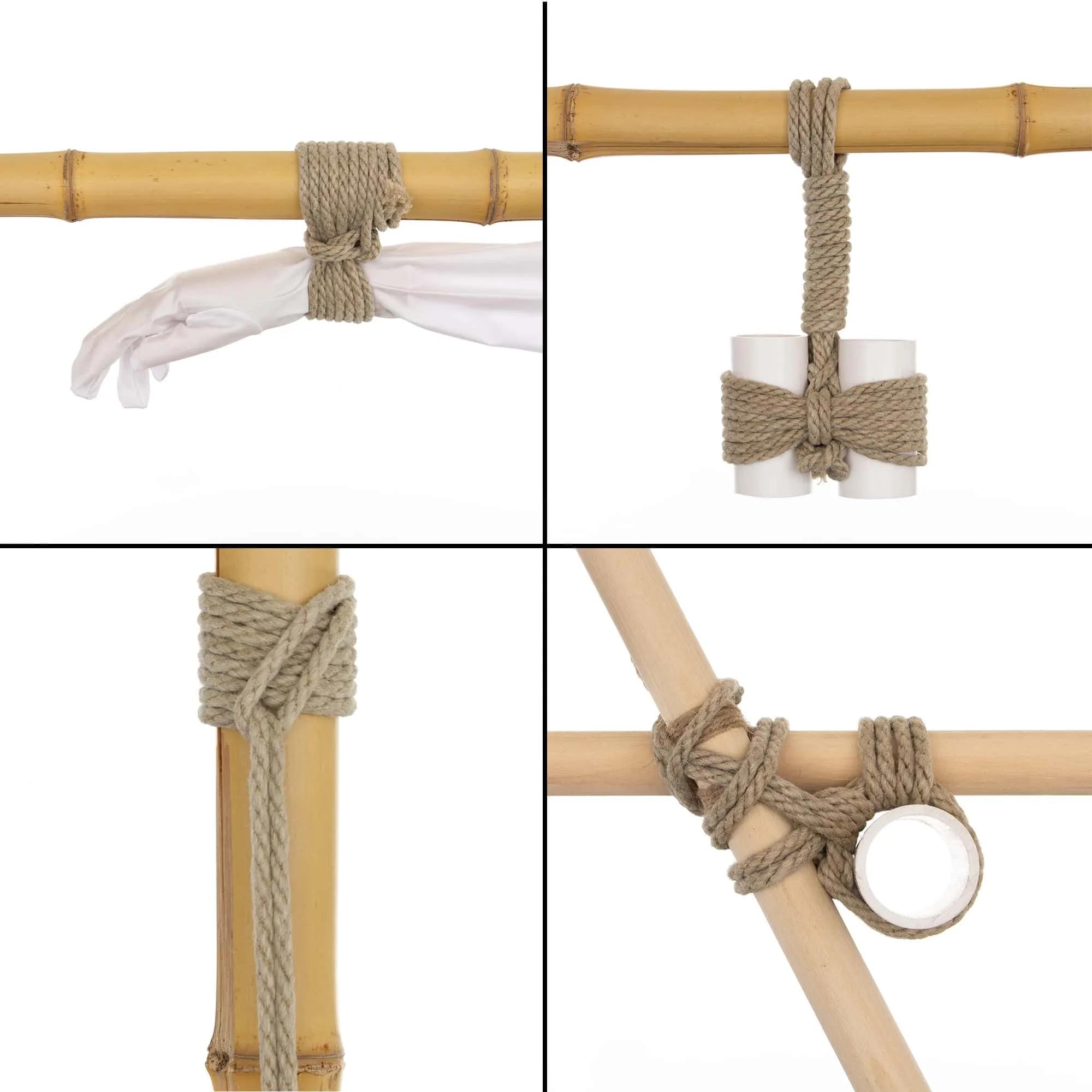
Bamboo Bondage - Attaching
A variety of ways to attach your partner to a pole or a frame
Attaching to Bamboo Bondage
By attaching bamboo bondage to your scenes you can get even more variety by incorporating a bondage frame. These are often made by add rods of bamboo, perhaps tied together in some form of frame.
Creation of a frame and related techniques are the subject of other tutorials, but regardless of which you choose, you will need to attach your partner to it. That is what this tutorial is all about!
There are many, many ways to attach your partner to a frame. You may have rope already on them and wish attach the rope to the frame. You may wish to start with them free and tie them to the frame with a fresh piece of rope. You may wish to tie them directly to the frame or to allow them a a little bit of tether, and a little bit of freedom of motion (and therefore greater frustration when they realized that that does not help them get free).
This page shows you many different methods for attaching your partner to a pole or a frame. There are many others not included here. Find what you liked best.
Safety: It is vitally important that you keep safety in mind when tying someone. When you create a cuff, you need to be able to slide at least two fingers into that cuff, between the rope and their skin; if you cannot, it is too tight. I point this out a few times in the below, but not every time. Remember to keep safety in mind at all times.
One technique that I do not like, is tying a wrist or ankle directly to a pole using a Square Lashing or related technique. It is far too easy to make the ropes too tight and, while this can be done safely if the rigger is being extremely careful, my personal opinion is that it is too easy to make a mistake, and I don’t normally recommend this technique.
Note: On this page I sometimes use white PVC tubes or hand forms to stand in for wrist, ankle or neck. I do this so that you can more easily see what’s going on with the ropes.You should already know the following ties:
Attaching Bamboo Bondage to a Double Column
Safety: This technique runs strands of rope inside of the cuff ... so you will be taking space inside the cuff. This means that you need to start with a cuff that is a little more loose than normal so that it is not too tight at the end of the tie. Remember, for nerve and blood flow safety, you need to be able to slip at least two fingers inside the cuff, between the rope and the skin when the tie is complete.Be especially careful with this pattern. It is very easy to make the cuffs too tight if you aren't paying attention. Remember, for nerve and blood flow safety, you need to be able to slip at least two fingers inside the cuff, between the rope and the skin when the tie is complete.If you already have an Extended DC, you can just attach it directly...If you already have a tied double column, and want to connect it to a pole, but can't reach the pole...Ending 1 - WrapEnding 2 - Repeating Cow Hitch or Lark's Head StyleA rapid and flexible way to tie three parallel columns together … say two ankles and a pole…
Artists Corner
Connecting a Single Column
Tying a Single Column directly onto a frame, in parallel to the pole. This version is simple and attractive. This technique can work well if the bamboo is approximately the same size as the wrist, but does not work well if the bamboo is significantly larger or smaller.
Safety: Remember, for nerve and blood flow safety, you need to be able to slip at least two fingers inside the cuff, between the rope and the skin when the tie is complete. As you are tying to something solid, take care to provide enough space between the wrist and the pole so that the cuff is not too tight when you cinch it.Tying a Single Column directly onto a frame, in parallel to the pole. This version adds a degree of control immediately, even before the tie is complete. This technique can work well if the bamboo is approximately the same size as the wrist, but does not work well if the bamboo is significantly larger or smaller.
Safety: Remember, for nerve and blood flow safety, you need to be able to slip at least two fingers inside the cuff, between the rope and the skin when the tie is complete. As you are tying to something solid, take care to provide enough space between the wrist and the pole so that the cuff is not too tight when you cinch it.If you already have a Single Column in a cuff, you can connect that cuff directly onto a frame, in parallel to the pole. (Technique to do so perpendicular is below.)
Safety: This technique runs strands of rope inside of the cuff ... so you will be taking space inside the cuff. This means that you need to start with a cuff that is a little more loose than normal so that it is not too tight at the end of the tie. Remember, for nerve and blood flow safety, you need to be able to slip at least two fingers inside the cuff, between the rope and the skin when the tie is complete.If you already have a Single Column in a cuff, you can connect that cuff directly onto a frame, perpendicular to the pole. (Technique to do so in parallel is above.)
Safety: This technique runs strands of rope inside of the cuff ... so you will be taking space inside the cuff. This means that you need to start with a cuff that is a little more loose than normal so that it is not too tight at the end of the tie. Remember, for nerve and blood flow safety, you need to be able to slip at least two fingers inside the cuff, between the rope and the skin when the tie is complete.This is one of the simplest methods to connect a Single Column to a pole at a distance. But it is only suitable if fingers cannot reach the knotsThis is very similar to the technique below (v2), except that I use the two Half-Hitch concept above as the starting pointThis is the way that I usually choose when doing a distance connection. This is very similar to the technique shown above (v1), except that I don’t start with two Half-Hitches and I finish off slightly differently. This just reinforces the point that there are hundreds of ways to make these connections
Connecting to a Junction of poles or bamboo
You can do the same thing with a larger Single Column, for example a rope collar
Creating Anchors
The Klemheist Hitch is a great method for attaching a rope to a pole in such a way that it will not slide, but it only works one direction. This technique is used by many riggers to create an anchor for vertical pole suspension. This also works with both rope and flat strapping like the tubular webbing used by climbers.You can use a Klemheist Hitch to create an anchor for another tie...You can also create a Klemheist Hitch with a tail or working end. This can be a great way to keep a person from trying to build up slack or to work the pole free.The Prusik can be used to anchor a pole in place so it cannot slide out of place, either direction it is pulled. This can be helpful to keep your partner from sliding a pole out of position and thereby undo your hard work at keeping them contained. ;) This works wonderfully with rope that has good tooth.