
Quick Releases - Building in 'Outs'
By Lazarus Redmayne
Bondage is power exchange
When a person allows you to tie them up -- especially in such a way that they are truly helpless -- that is a moment of deep trust ... and deep responsibility. They are helpless. They are unable to do things for themselves that they can normally do. They cannot take action to help or protect themselves if needed. Only you can take action. That makes YOU responsible for doing those things that they cannot. That is true power exchange.
They are not without responsibility, though. They are responsible for telling you what they need, giving you critical information about their health and safety, be it physical, psychological or emotional. You are responsible for appropriately responding to that information. You have a Duty of Care, in the full, legal sense of that term. Take that responsibility seriously. If you are unable or unwilling to do so, do not make them helpless.
“Duty of Care” is a legal obligation imposed on an individual, requiring adherence to a standard of reasonable care to avoid acts or preventable events that could foreseeably harm others.
You may need to release your partner quickly
There are many reasons why you might need to get someone out of bondage quickly...
- They report what may be a nerve compression issue and you are unable to quickly resolve it by moving rope.
- Your partner begins to feel ill, dizzy or disoriented.
- A fire alarm goes off.
- A tornado siren sounds.
- You hear a knock at the door and a deep voice says, "Is everything ok in there? We've had reports of strange noises."
- You hear a knock at the door and hear, "Hi, Honey. I brought your favorite casserole!”
- ...and so many other scenarios.
...or they might need to get themselves out...
- You slip, hurt yourself and are unable to get up
- You lose consciousness
Consider these examples:
- Your partner is standing in your living room, ankles and knees tied together, arms bound tightly to their body, behind their back. If they start to fall over there is very little they can do to stop their head from striking the edge of that nearby coffee table. Only you can do that. Firstly by tying in a place that does not have any hard or sharp objects they can fall on to; secondly, by not having them stand unless specifically necessary; and, third, if they must be standing, by having a firm grip on their harness, ready to instantly take their weight and move them in a safe direction if they lose their balance.
- Your tying partner is diabetic and begins to go low, or loses consciousness. Only you can give them their glucose, fruit juice or a sugar soda (based on the plan that you discussed and agreed to before-hand).
- You are diabetic or have some other condition where you there is an anticipatable risk that you might become unconscious.
- You have a heart attack or stroke, or you trip and your head strikes a hard surface, knocking you out ... what happens to your partner?
Plan ahead, have options (great quick-releases)
One thing you can do to reduce the risk in all these scenarios is to make sure they are not entirely helpless, or to make sure you are able to untie them very quickly if needed.
The classic way is to have some means to cut the rope that is within reach. And if you want a dark, intense scene, where a feeling of real helplessness is important to you, perhaps that’s the best plan: Simply rely on your emergency rope-cutting tools (EMT Shears or and EMT Hook), but if your plans allow for something less intense, then, instead of cutting rope, you can build quick-releases – “outs” – into your bondage!
These techniques can often get your partner out of rope more quickly and with less risk than cutting rope!
Practice these techniques, get comfortable with them. If some situation arises that requires you to quickly release your partner and you can do so with calm confidence your partner’s confidence and trust in you will definitely go up!
These two are very useful.
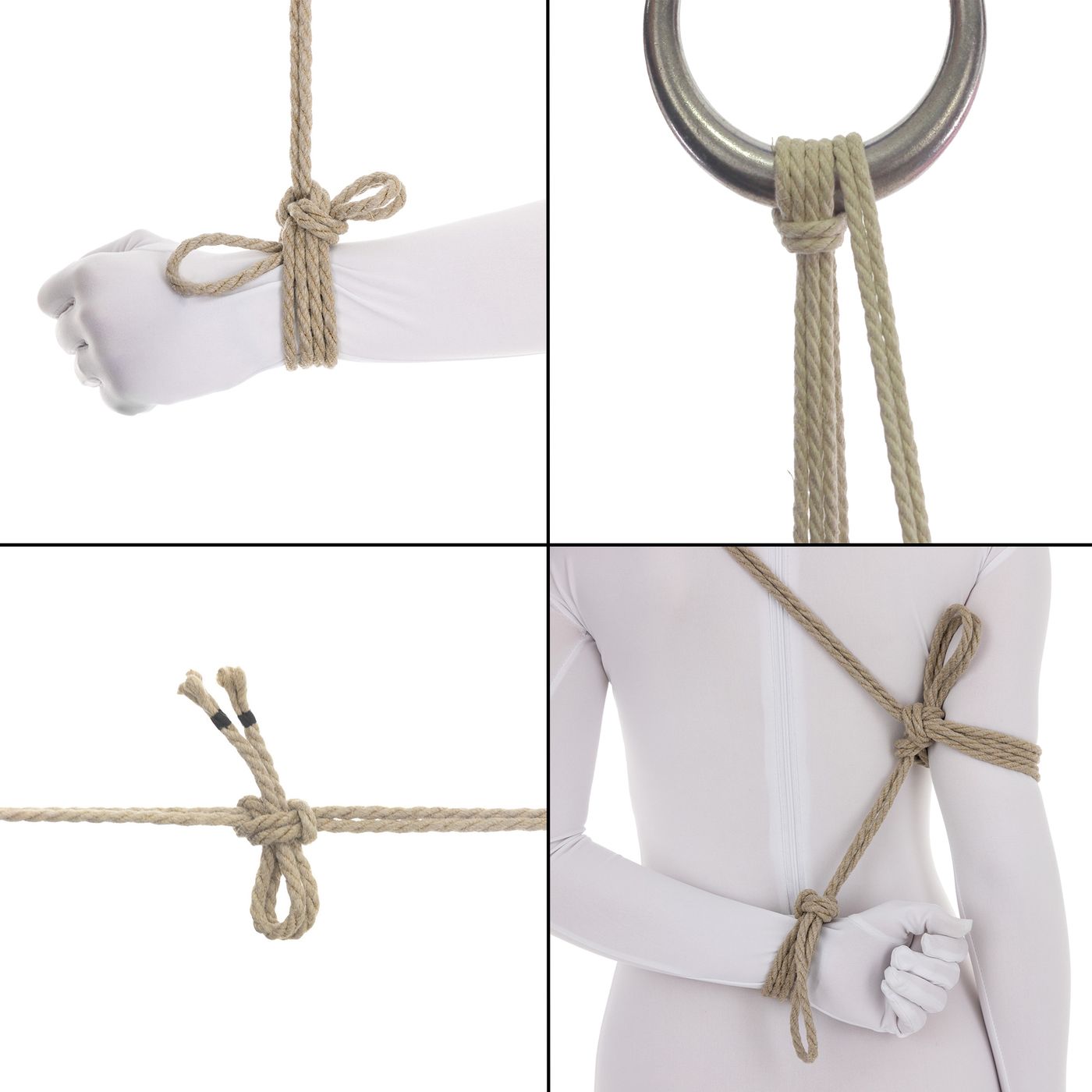
The Slipped Somerville Bowline is an incredibly useful quick release. Unless my tying partner has a helplessness kink, I start every box tie with this technique. Here is an example of using the quick release.
In suspensions, using a Munter Hitch as either your suspension friction itself, or above the ring for an emergency let-down capability that can bring the whole rig safely to the ground in seconds, removing gravity as a force of concern and often immediately resolving the issue without the risk of cutting rope under tension.
These are more special-purpose, but can be very helpful, too!
If you need an inline single column, the Slipped version of the Hojo Cuff can be helpful. It is not a full release, but it can quickly add slack to release tension and reduce stress to give you time to untie gracefully.
The Slipped Sheet Bend is one way to extend your rope that allows you to quick disconnect the ropes, if that would be helpful.
A quick-release single column belt introduced in the IOTK
In the IOTK tool kit, we introduced another way to create a quick-release strap. This technique can be helpful if you are creating some kind of intricate harness. If you use this as the starting wrap, you can quickly remove that wrap, if needed, which can let the whole harness come off quickly. You can see an example of this in Tidefall.
Quick releases are *not* appropriate for every scene. (Brats, people that *need* to be helpless)
Adding a quick release is a personal choice and is definitely not appropriate for every scene. For example:
- Brats want to fight and push and try to get out, and most of them are very disappointed when they are actually able to escape.
- For people (Top or bottom) that have a helplessness kink, if the bottom can escape, it isn’t true bondage; without true helplessness, they cannot experience the release they need and thus cannot sink fully into the scene and achieve subspace, Dom space, or other goal they may have.
Here are a few ideas for dealing with such cases:
- Set a boundary: “Brat all you want. If you find weaknesses in my ropework OTHER than these elements that I include to keep you safe, those are fair game. But you don’t get to claim victory if you escape by using a safety quick release.”
- You can design your ties to include quick-releases but keep them away from busy fingers! (This can be a fun creative challenge. Giving them a chance to release themselves if they are clever and can find a way to hook a quick release on something, for example.)
- You can put them in bondage gloves to keep those fingers contained. This reduces their ability to free themselves but leaves you free to put a quick release wherever you want it. This is less suitable for cases where you include the quick release specifically for them to use if needed in an emergency. (If, for example, you, the rigger, have medical condition that puts you at risk of losing consciousness.)
- You can let them free to explore, but make finding the real quick release a treasure hunt by adding decoys all over the place, inline Alpine Hitches, free tails that can’t be untied, etc.
Examples
Quick Releases - Three in one harness
This is a modified version of the Bolero Box Tie, but with three quick-releases. (Not that you would actually need all three.)
We start with a Slipped Somerville Bowline...
When we need to extend rope, we use Slipped Sheet Bend...
...then used Slipped Hojo Cuffs on each side to pin the arms to the side. Good times!
Comments
Loading comments...
Sign in to leave a comment.