
Lark's Head Knot
By Lazarus Redmayne
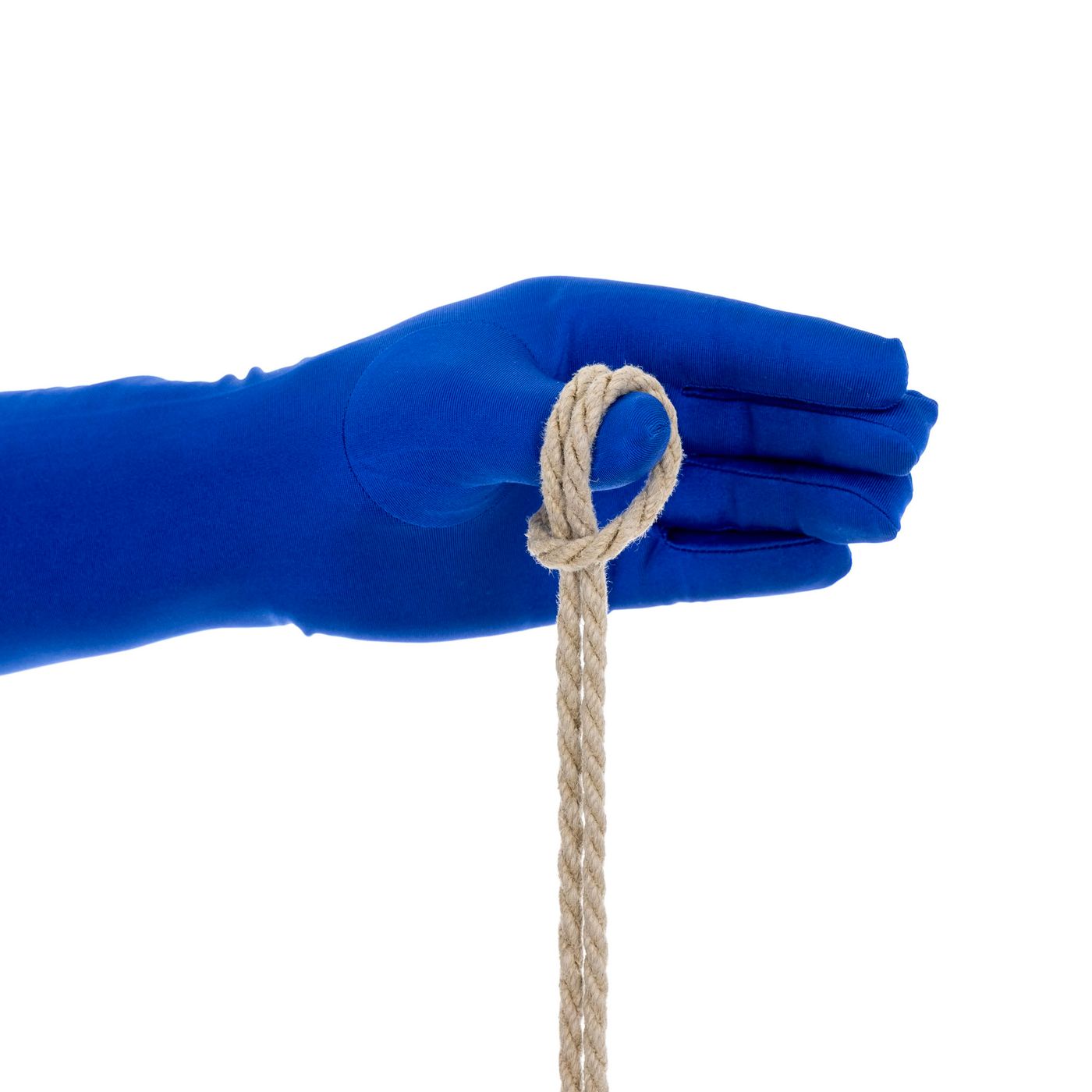
A Lark’s Head is the simplest sliding knot. If used by itself, it forms a collapsing loop. That means that if you pull on the tail, it gets tighter. Because of that, a collapsing loop should never be used directly as a bondage cuff. That said, it is a very common first step in the creation of many other ties.
Examples:
- Lark's Head Single Column
- Lark's Head Double Column
- Extended Lark’s Head Double Column
- Unchastity Belt (and many other hip/waist harnesses)
- Shinju (and many other chest harnesses)
- Light Elbow Harness
- Heavy Elbow Harness
- many others...
Risk Management and Safety
Do not use a Lark’s Head by itself as a cuff. Doing so is dangerous. A Lark's Head by itself is a collapsing loop. It needs to be converted to a non-collapsing loop to be suitable for use in bondage. What you see here are the first steps of creating the Lark’s Head Single Column, the form that is suitable for use in bondage
Method 1 — Pull a Tail Through a Bight
This is the most common way to create a Lark’s Head in practice. With this method, you create the Lark’s Head around something without having to go over the end as with Methods 2 and 3. This is is the first step in creating a rope cuff or strap when doing so using the Lark’s Head Single Column.
We want to make a Lark’s Head around the wrist as the first step of making a wrist cuff.
Fold a rope in half. Wrap it around your hand with your fingers through the bight.
Grab the tail with those fingers
Pull the tail through.
Note that I have twisted my wrist so that I am pulling the rope through the larger hole of the bight and not against the bight itself. This reduces friction and lets the rope move freely.
This is a Lark’s Head Knot
Method 1 — Smoothly tying a Lark's Head. A Foundational skill!
Tying a Lark’s Head is very simple, but there are a few tips and tricks to incorporate good rope handling skills to make tying this very smooth as well. Mastering basics like this make it seem to others that you move rope like a natural extension of your will. This will boost their impression of your ability and increase your rigger cred. ;)
To see this in action, watch the video. You see 1 thing ... I'm doing 11 things!
Video Contents:
- 00:08 - Tying a Lark's Head at speed
- 00:25 - I was doing 11 things! Here are the details
- 01:55 - Let's count them down ... a bit faster
In the video, here is what I am doing at each number:
- Hold the bight of your rope in your dominant hand.
- Place that hand on one side of the thing you are tying and your off hand on the other.
- Hook the bite with your off hand using two fingers, with those fingers pointed toward the thing that you are tying.
- Pull the rope around, keeping the lines parallel and not twisted.
- You fingers are now automatically positioned. Feed the tail to them. Grab the tail with a scissor grip.
- Turn your hand 90° to position the tail so that it will move through the big hole of the bite and not drag against the bite itself.
- Pull the tail through using your off hand while simultaneously using your dominant hand to control the end of the tail so it doesn’t flail around and strike something or someone.
- Continue to control and guide the tail until the ends are through the hole.
- Reverse tension.
- Adjust tension.
- Adjust location the node. (These last three things can be simultaneous or in any order.)
Method 2 — Create a Lark’s Head on a Bight
There are times when it is helpful to create the Lark’s Head first, then put it over the end of something. This is one way to Extend Rope.
Form a bight in the middle of the rope.
Put two fingers through the bight.
Fold it down on itself.
Place your fingers around the tail, touching your forefinger to your thumb.
Fold the bight around the tail so the two loops are aligned.
This is the Lark’s Head Knot.
If needed, you can then pull the bight to make the loop bigger so you can slip it over the end of whatever you are tying.
Method 3 — One-Handed Method
This technique gives the same results as Method 2, but can be done with one hand! This can be useful when Extending Rope; you can keep tension on the end of the first rope and use this technique to create a Lark’s Head on the other rope prior to connecting them.
Drape the bight over your wrist or over two fingers.
Reach down and grab the tail.
Shake the bight off your wrist and down over the tail.
Shake the bight off your wrist and down over the tail. 4. Slide it onto something. In this example, a thumb.
This is the Lark’s Head Knot.
…from another angle.
Comments
Loading comments...
Sign in to leave a comment.