
Extending Rope
By Lazarus Redmayne
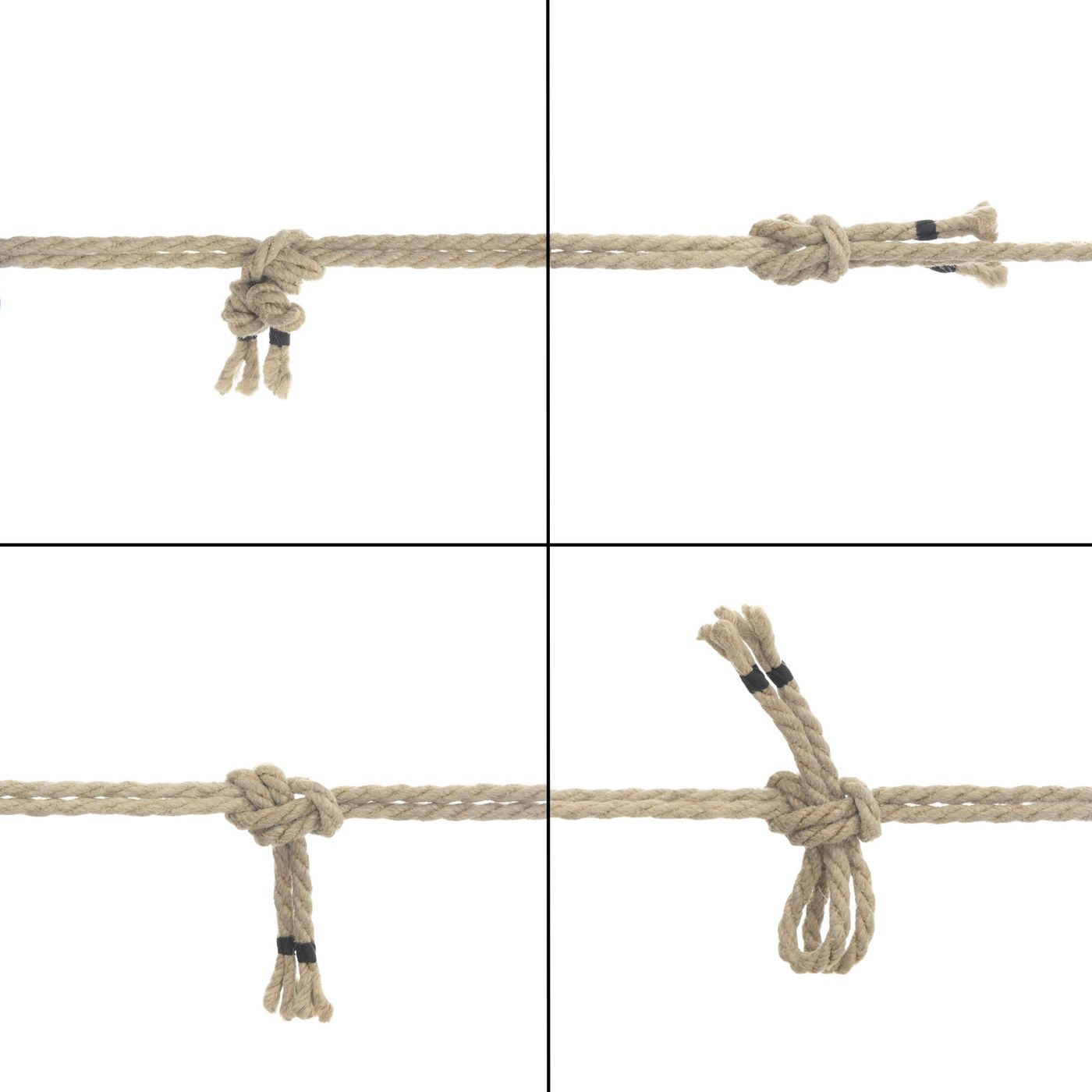
Many riggers only carry ropes of common lengths like 30’ and 15’. These are useful for different purposes and are easy to handle. (More on this at Rope Lengths & Thicknesses.)
We do this because it saves us time when tying for a scene. Many common ties require you to pull the tail through multiple times. With shorter ropes, you can pull the tail through in 1-3 moves. But the longer your rope, the more moves (and more time) each tail pull will take.
However, there are many ties that require more than 30’ (9m) of rope—many chest and waist harnesses, for example. You will either need a very long rope, or… you can just learn how to extend your rope when you need more! Once you understand these simple techniques, there is no need to use extra-long ropes harnesses for most cases. (That said, some riggers still carry extra-long pieces for cases where they specifically want to have no rope joins, for example if doing some specialty rigging for a photo shoot.)
Here are several techniques that will allow you to simply extend your rope and continue.
Rope Needed
For this tutorial, I used Natural and Blue 6mm provided by my affiliate Twisted Monk.
Check them out for some amazing hemp rope!
Video
(Reminder) Tying a Lark’s Head with one hand
When extending a rope during a scene, keep one hand on the prior rope, maintaining the tension, while you add the new rope. This keeps that connection with your partner alive. They continue to feel your attention during the pause. If you do this, you will need to prepare and add your new rope mostly using just one hand, so here is a useful technique to create a Lark's Head using only one hand.
Drape the bight of a new rope over your thumb and forefinger.
Spread your thumb and forefinger wide.
Turn your hand so that your fingers are pointing down and can…
… reach around the stem like a pincher to touch each other.
Shake your hand a bit so that the bight falls down. This has now formed…
… a Lark’s Head knot!
(1) If the ends of your rope are knotted and are even … Lark’s Head
If the ends of your rope are knotted and are even, you can use this fast connection method. It is a bit bulky however, so you may want to use one of the techniques below anyway…
Some people like to have knots at the end of their rope. If you do, and they are even, adding a new rope is easy.
Get your new rope and find the bight.
Create a Lark’s Head, perhaps using the technique above.
Reach through the Lark’s Head to grab the tail of the previous rope.
Pull the knots through the Lark’s Head.
Tighten the Lark’s Head.
They are now joined.
This technique does not work well if the ends are not even.
(2) If the ends of your rope are not knotted | Ends are uneven | To join not at the very end … Lark’s Head
If the ends of your rope are not knotted, you can still use a Lark’s Head … by “collapsing” it into a Square Knot! This technique is also helpful if the ends of your first rope are not even.
Maintain tension on the previous rope. This lets your partner continue to feel you and your attention even as you add rope.
Get the rope you will add and find the bight.
Add a Lark’s Head.
Reach through the Lark’s Head and grab the tail of the prior rope.
Pull the tail through.
Move it to a point 3” (~7 cm) or more from the end and tighten it so it has a light grip.
Bend the prior rope into a “U” shape around the strands of the new rope.
Now flip the bight of the new rope – this part of the Lark’s Head – to the other side of the node.
(Here it is in mid-flip.)
Move it entirely to the other side, like this.
You have just joined the new rope by collapsing a Lark’s Head into a Square Knot!
You can continue your tying from here.
Cool Feature #1 - You can easily move the node
If the node ends up being in a bad spot – perhaps it is on a bone or a point where it may lead to a compression injury – it is easy to move! Just grip the tail …
… the pull sharply to shift the knot back over to a Lark’s Head.
Then slide the Lark’s Head to a different point.
Then collapse it back to the Square Knot form.
Like this. Now that node will lay on a different spot on your partner’s body.
If you end up with strands that are too long, use them up in whatever way works best for the situation. Perhaps you can tuck the behind a strap or ….
… if nothing else, you can just make a half hitch with them around the prior rope.
Like this.
Cool Feature #2 - This works even if the ends are not even!
This technique works just fine even if the ends of your rope are not even.
Do the same thing…
… and it will still grip just fine.
You can use up the longer strand by wrapping it around the shorter strand …
… then tucking it between the strands of the prior rope, like this.
As long as you maintain tension on the rope, the ends should stay in place, out of your way.
Using this technique in action...
Do Steps 1-7 from "Using this technique in action" from Technique 1.
Run the old rope through 2” (~5 cm) or so…
Bend the first rope back on itself, around the strands of the Lark’s Head.
Slide the bottom of the Lark’s Head over and on to the first rope.
Like this. This has “capsized” the Lark’s Head into a Square Knot!
Tighten.
Your rope is now extended.
(Optional) You can wrap the tails of the first rope around the rope to keep them out of the way.
(3) If the ends of your rope are not knotted | Ends are uneven | To join not at the very end … Sheet Bend
This is another great technique that will work regardless of whether the ends of the prior rope are even or not. This one also works well even if the diameter of the rope is different (a rare circumstance in rope bondage, but it’s good to know how to deal with it nonetheless).
Maintain tension on the prior rope. Get your new rope and find the bight.
Place the bight over the prior rope at the point you want the node to be.
Now use the strands of the prior rope to tie a Half Hitch around the new rope, like this…
…
That’s it! The ropes are joined.
(4) Using (3) to build an “out” into your bondage with a Slipped Sheet Bend
There are many reasons why it can be helpful to be able to quickly untie your partner. Many of those reasons are covered in our article on Scene Negotiation & Planning. Here is another technique to build a quick-release into your bondage, with only one simple change:
When tying your Half Hitch, instead of pulling the tail all the way through like this …
… only pull the tail partway through …
… so you have a reasonable loop on this side …
… but leave some of the tail on this side.
This is a Slipped Sheet Bend.
If you need to release it quickly, grip the tail …
… give it a sharp pull …
… and the knot will release …
… allowing the ropes to separate.
(5) Adding a new rope to the stem using a Lark’s Head
You can completely end the first rope (use up extra rope and then tie off the end), and then add a brand new rope to any line that is under tension, the stem for example, or a chest or waist strap.
Run the bight of a new rope under some existing strands, with the bight pointing in the direction you want the tail to naturally flow.
Pull the tail through that bight. If you just needed a new double strand, you are done.
Example of where this might be used: You are tying a chest harness and run out of rope just as you finish the top strap. You could lock that prior rope off to itself and use this technique to add a rope for the shoulder straps and front. (As opposed to connecting the new rope to the end of the last rope as usual.)
If you want a single strand running the opposite direction, reach under the strap and hook one of the strands of your new rope.
Draw it under the strap, placing it between the outer loops of the Lark’s Head.
Now you have a line running the other way as well.
See an example of this below, used to add a new rope to a Hishi Karada. This would be useful if you want to place the diamonds closer together and have more lines tracing your partner’s skin.
But note that this technique only gives you one strand running one direction …
… what if you would like to have two strands?
Example:
Here we have completed a Hishi Karada, used up the extra rope and tied it off. Now we want to add a new rope so we can do something different around the hips.
You can connect to any line under tension.
Run the bight under the line, then reach through it to hook the tail.
Tighten to complete the Lark’s Head.
If your tie calls for your ropes to be doubled, you can simply continue your tie from here.
If not, as in this case with the Hishi Karada, you can separate the tails and…
…run one underneath the stem so that it goes in the opposite direction. Continue your tie!
(6) Adding a new rope to the stem using a Cored Square Knot
There are several ways to join a rope to a stem such that there are two strands leading out of the new node in both directions. An Overhand Knot or a Crossing Hitch, for example (not shown).
Here is another approach, using a Cored Square Knot, that happens to be one of my favorite for its attractively symmetrical and streamlined appearance, and ease of adjustability. You will need two ropes
(Aside) By the way, when adding rope to a stem, it can be helpful to make and explicit choice as to how to arrange the ropes in that strap. This leads to a more consistent, professional appearance.
When a Cow Hitch is involved, the rope will naturally arrange such that the outside two strands fall behind the inner two strands. Here I just leaned into that natural tendency.
Run the bight of rope 1 underneath the strand.
Get a second rope.
Run the bight of rope 2 through the bight of rope 1 and over the top of the stem.
Reach through the bight of rope 2 and hook the tail of rope 1.
Pull the tail all the way through. Note the classic form of a Square Knot surrounding the stem as a core.
Tighten.
Now you have a double strand leading in both directions from a streamline attractive node.
The thicker lines distribute force across a wider area than do single lines and they have that lovely eastern-style aesthetics.
One other cool feature: It is easy to move this node up or down slightly if needed.
Here I slid it down slightly …
… to make room for this pattern.
Technique 1 - If the ends of your rope are knotted and are even
Use a Lark's Head to grab the old rope. This is a very fast way that you can use if the ends of your rope are knotted and even.
If your rope has knots on the end, you can easily add rope with a Lark's Head
Form a Lark's head in the middle of your new rope
Reach through that LH and grab the end of your old rope
Draw the old rope though the LH
Collapse the LH onto the old rope
Pull to tighten. Done!
Ready to keep tying
Using this technique in action...
Keep tension on the first rope with one hand.
With the other, get a new rope.
Drape it over your wrist, grab the tail and shake off the bight to…
…form a Lark’s Head Knot.
Reach through that Lark’s Head and grab the knots on the first rope.
Transfer the Lark’s Head to the first rope.
Like this.
Tighten the Lark’s Head.
Slide it to the end where it will grip the knots. Continue your tie!
Technique 2 - If the ends of your rope are not knotted | Ends are uneven | To join not at the very end
If the ends of your rope are not knotted, you can still use a Lark’s Head … by “collapsing” it into a Square Knot! This technique is also helpful if the ends of your first rope are not even.
Begin with the ends of your current rope...
Perhaps you have been tying a TK and you need more rope...
Form a Lark's Head knot at the middle of the rope you are adding. Reach through that Lark's Head so you can grab the end of the old rope
Run the old rope through 1-2 inches (3-5 cm), and bend it back on itself
Grab the middle of the Lark's Head...
...and flip it over the old rope.
This has formed a Square Knot!
Tighten to complete!
...and then carry on with your tie!
Using this technique in action...
Do Steps 1-7 from "Using this technique in action" from Technique 1.
Run the old rope through 2” (~5 cm) or so…
Bend the first rope back on itself, around the strands of the Lark’s Head.
Slide the bottom of the Lark’s Head over and on to the first rope.
Like this. This has “capsized” the Lark’s Head into a Square Knot!
Tighten.
Your rope is now extended.
(Optional) You can wrap the tails of the first rope around the rope to keep them out of the way.
Technique 3 – Adding a new rope to the stem
You can also completely end the first rope (use up extra rope and then tie off the end), and then add a brand new rope to any line that is under tension, the stem for example, or a chest or waist strap.
In this example, we have completed a Hishi Karada, used up the extra rope and tied it off. Now we want to add a new rope so we can do something different around the hips.
You can connect to any line under tension.
Run the bight under the line, then reach through it to hook the tail.
Tighten to complete the Lark’s Head.
If your tie calls for your ropes to be doubled, you can simply continue your tie from here.
If not, as in this case with the Hishi Karada, you can separate the tails and…
…run one underneath the stem so that it goes in the opposite direction. Continue your tie!
Comments
Loading comments...
Sign in to leave a comment.