
Hashira (Vertical Beam) Shibari
A few of the *many* ways to tie your partner to a vertical beam, column, post, pole, etc...
Hashira (Vertical Beam) Shibari is bondage to a vertical beam, perhaps a pillar in your basement, a post, a tree, a mounted/anchored rod of bamboo, etc… This practice is inspired by the traditional architecture of houses in japan, where exposed beams are a common part of the aesthetic. (For simplicity, I will just say "beam" throughout the rest of this tutorial, but when I say "beam" I am including any immovable vertical object to which you want to tie your partner.)
There are many, many positions and scenes that can be done this way. There is something about being bound to an immovable object that is very … evocative … the permanence of thing enhances and reinforces the feeling of helplessness. Many people quickly drift into subspace in scenes like this.
A word about suspensions involving a beam or pole: This type of bondage is unlike any other. Hashira suspensions are considered by many to be one of the most risky types of bondage you can do. It is difficult for both the top and the bottom. Even if you are already expert at other types of rope, even suspension, you should approach this new practice as if you are a beginner. Everything works just a little differently than with other practices. Take it slow. Build your experience and understanding over time. (Much more on this below.) As with any other type of higher-risk activity, it is always best for your first few ties to have someone there that is more experiences and can point out areas for improvement or safety. Review Safety Basics and Suspension Safety, and all the Hashira-specific Safety material throughout this tutorial. Safety is paramount and is your responsibility.
Below you will find a whole suite of tutorials on Hashira Shibari. I separate the various types of ties into two categories: Those that can be done and require no Hashira Anchor Point or Hard Point, and those—including suspensions—that do require a Hard Point. …And I show you some methods for tying an Hashira Hard Point if you need one!
This tutorial is built on others going before it in the Bamboo Bondage series. If you see a reference in square brackets like this "", it refers to one of the techniques shown on the Bamboo Bondage - Attaching tutorial; so, if you have not already done so, go familiarize yourself with that page before delving into the tutorials below.
Scenes that do not require a Hard Point
Here are a few ideas for things you can do if you have an unmovable anchored beam, ideas that do not require you to create an Hashira Anchor. There are many more as well. This is just to get you started...
Creating an Anchor on a Vertical Beam
The following scenes require that you create a hard point or anchor on your beam. If you want to explore these options go learn and practice the Hashira Anchor first. The tutorial covers a variety of techniques that can help in a variety of situations.
Floor scenes that require a Hard Point
Hashira Suspension Safety & Planning << Crucial. DO NOT SKIP THIS
The traditional approach to Hashira Shibari where the hard point is rigged exclusively to the vertical pole or beam (and is not also supported by a cross beam or overhead beam) is considered by some to be one of the highest-risk types of bondage when used for suspension. This is expert-level tying.
If you have just started with rope bondage, don’t start here; go work through the Rope 101 and 102 courses and then do some serious practice with a partner so you really understand how rope moves and how human bodies interact with rope before you start to do any kind of suspension, but particularly this type.The physics of Hashira suspensions is such that the weight of the body is often carried by the chest or the legs. Often, a hip harness is not included. This can result in having too much pressure on the chest or abdomen--it can squeeze them so tightly that they cannot breathe. Pay close and careful attention to how the load is distributed so that you avoid this. Monitor constantly. Always be ready for immediate emergency release.
- For both Tops and Bottoms:
- Build your experience and grow over time. Start with scenes that leverage a hard point but do not include any actual suspension. Then move to partial suspension. Then, as you really understand the rope and how you move in it / how your partner moves in it, then try some simple suspensions. Grow from there.
- Note that this type of bondage can be extremely challenging for a bottom, even one that is extremely experienced in regular suspensions. Introducing a static element like the Hashira means that many of the options that a bottom normally has allowing them to shift position and relieve tension are not available.
- It is entirely normal for the first few flights to only last a few minutes before the bottom needs to come down. It can still be a very successful scene, still be very powerful, even if short.
- Tops: If this happens your bottom may need extra reassurance that it was a good scene and that they did well. They may feel insecure if they were only able to stay up for a short time. This is a common reaction for people just trying this for the first time. Reassure them. It is OK. Experience will allow for longer flights if that is something you both want and want to work toward.
Before you ever try this with a partner, you need to practice tying an Hashira Hard Point many times. Make sure you have the experience to tie a bomb-proof hard point before you plan a live suspension scene.
- Tie it on many different types of surfaces.
- Test all your practice hard points by loading them. (There are many ways to do this, but I like to do it with my own body weight. I do this with a loop of rock climbing webbing or a loop of rope that I keep in my bag. I run the loop through my hard point, then down, then I step into it.)
- Test the point under dynamic load. Move around, shift your weight, so you can see if the hard point shifts or slides.
- Make sure that the hard point stays rock solid, that doesn’t slide or move on your surface.
- If it moves, it needs to be retied … or perhaps you need to abort the scene altogether and plan something else.
- An important consideration: Unlike regular suspensions, you won’t have access to the whole main line; part of it is between your partner and the beam. This limits your rope handling options and needs to be planned for.
- As you work with several lines, it is easy for lines to get tangled or to have friction issues prevent movement of rope in the way you normally expect. Plan ahead where you want your anchor points to be to avoid getting jammed up.
- For your first few scenes, plan to use only one anchor point, then add a second and build from there as needed as you gain experience.
- Validate that your partner has experience with Hashira before you fly. Or grow and build that experience together. I recommend that you *check the anchor yourself* once it is tied, before you go up on it. This is something to include in the negotiation between you and your rigger. It is true that some riggers will be offended by such a request, but my personal feeling is that if a rigger take offense—if they are that arrogant or disrespectful of your need for your own personal safety—that you probably don’t want to be tied by that person.
- Be honest with yourself and your capabilities. This is unlike anything else. This is physically challenging. The first few times will be a learning experience for you; it will take time to understand and adjust. Be gracious with yourself.
- Be honest and clear with your top. Help them understand your experience level. If something feel wrong, speak up right away. Don’t wait. Don’t try to power through. A responsible rigger needs and wants to know things like that so they can adjust for your safety.
Hashira Suspensions
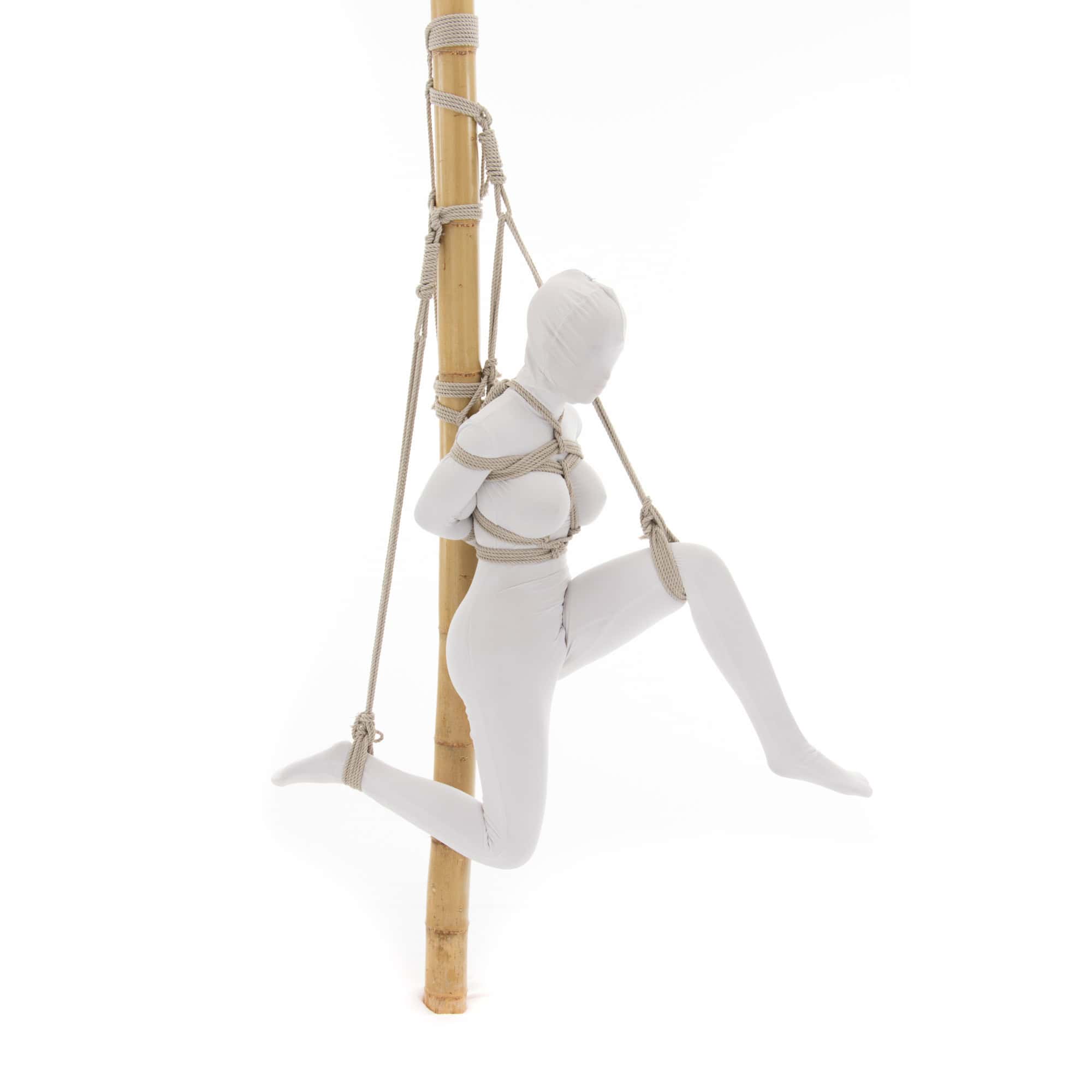
While I do many of my tutorials with a mannequin, I do suspension videos with a live human; you need to see how the person and rope interact. Unfortunately, COVID-19 precludes that at the moment. I have a number of people in my life that are high risk; therefore, I cannot work with live models for now. I will come back and add a video on this topic in the future, but for now, I will provide a few ideas and a few still images of options that you may find interesting and may wish to explore:This is a great one to start with because it allows both the the rigger and their partner to gradually test out each level of Hashira Shibari – fully standing > partial suspension > full suspension – while allowing a very quick reset to the previous stage if needed.
- Add a chest harness with good vertical support and then anchor that with their back to the beam
- Connect the suspension points of that harness to an overhead hard point so that it cannot slide down
- Have your partner test if it can slide by slowly lifting the feet. Make sure it is stable
- Make sure they are comfortable enough in the harness, adjust if you need to
- Then put a single column around one leg just above the knee and tie it up off the ground to the front or side of their body
- Over time this can be a predicament tie
- This can be made much more challenging by transitioning to a full suspension:
- Running Man option:
- Add a single column around the ankle of the other leg
- Pull the second leg up off the floor but behind
- Your partner can try to press in to their legs to manage their weight, but this quickly gets tiring
- M or Crab option:
- Add a single column just above the other knee
- Pull the second leg up off the floor just as you did the first (to the front or side) as into the “Crab” shape
- Your partner can try to press in to their legs to manage their weight, but this quickly gets tiring
- You can make it even more challenging by then tying their ankles (previously free to move somewhat) to their thighs or to the beam. This renders them almost completely immobile. This is an extremely challenging position for most people. Work your way up to this one over many sessions so that you know how you both react to the various stages before this...
Here are a number of other positions and ideas for you to mix and match to try out as you grow.
- Tie a firm harness on your partner and then tie them with their back against the beam. Then...
- Tie ropes to one ankle and then flex that leg backwards and up toward their back, then tie to an anchor to keep in position.
- If you do with just one leg, it is a partial suspension.
- Can be a predicament tie. Over time it gets harder and harder to stand on one leg and you have to fight between that and weight on your arms and chest
- You can make this much more challenging if you then tie up the second leg as well to make it a full suspension.
- Partner facing the beam, perhaps with a face on beam,
- Bottom out and knees on the beam (like a vertical kneeling position) if the beam is wide enough
- ...or feet on beam if they are flexible enough
- Partner's side against beam
- Horizontal suspension as you may have done from a standard hard point, but using the Hashira Anchor as that point.
- If insanely flexible:
- Wrap totally around the beam (horizontally) if they are flexible
- Back against beam (face up), then pull the legs back and up, positioning their feed on either side of the beam so that their toes point up the sides of the beam toward their head
- There are *many* more idea out there. Do a web search on Hashira Shibari for more!