
Wrap & Cinch Double Column
By Lazarus Redmayne
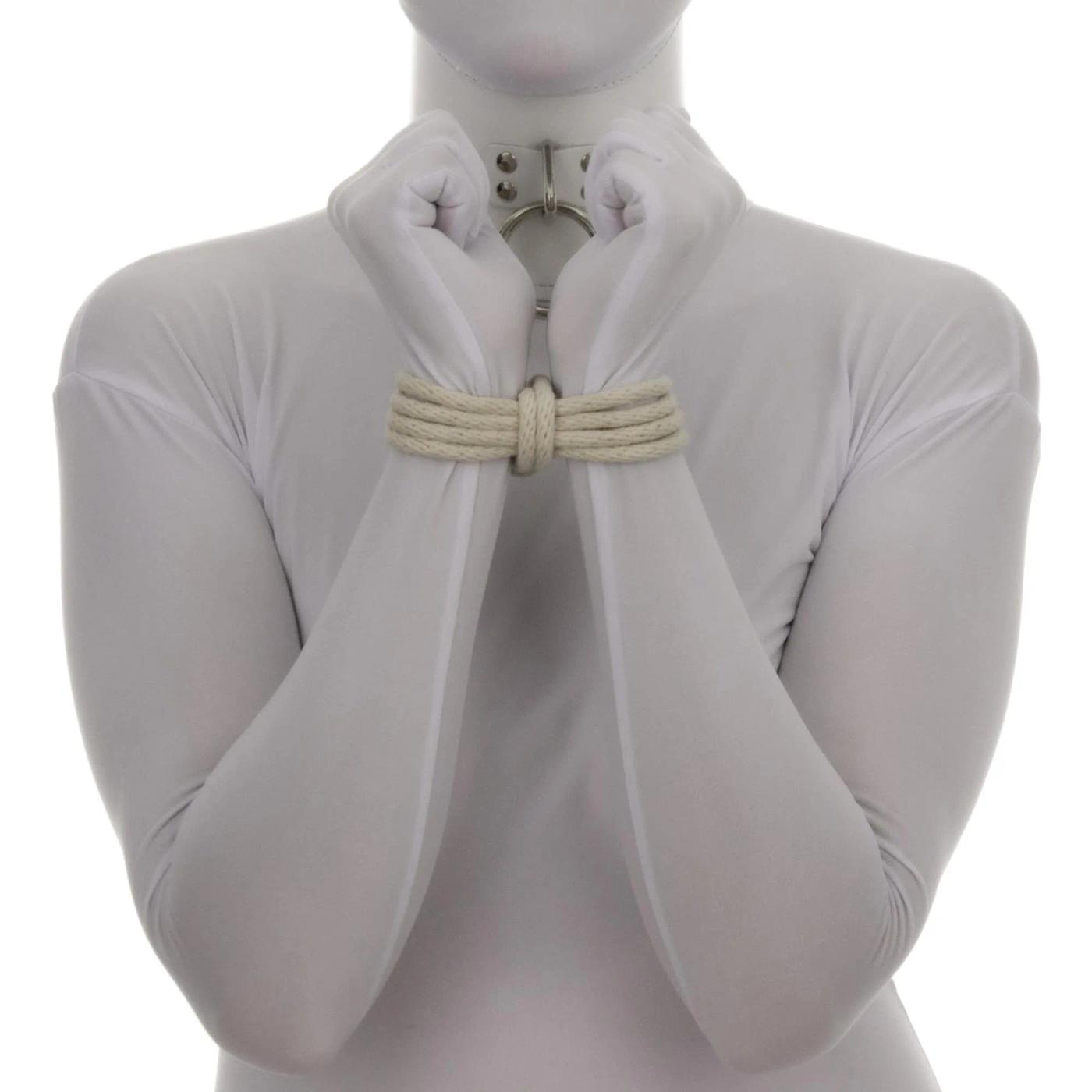
This is forward-tension double column. It is great for tying any two things together:
- Wrist to wrist
- Ankle to ankle
- Wrists to ankles
- Wrists to thighs
- Knee to knee
- Ankle to thigh
- Wrist to arm of a chair
- Even elbow to elbow (if your partner is ridiculously flexible)
It is simple to apply and yet results in a snug and secure tie.
A double column is pretty much the same as a single column, but with a cinch in the middle. The same idea can be extended to three columns (as in a TK) or more… I am going to show two versions, the standard just-tie-them-up version and a useful variation if you are going to put the tie under tension -- make it "load-bearing".
Risk Management and Safety
Wrists are sensitive, they must be handled with care. So “load-bearing”, means reasonable amounts of load. Hands attached overhead is fine, suspending someone by their wrists alone is not. More:
- Wrists have a lot of nerve and blood vessels near the skin on the inside of the wrists. Too much pressure there can impact blood flow or nerve conduction. Cuffs should never be too tight; you should always be able to run two fingers under a cuff.
- The wrist joint itself is also fragile. If you pull on wrists too hard, you can damage that joint or even push some of those small wrist bones into the wrong position. NEVER suspend someone by the wrists alone. Never tie someone in a position where rope is a applying heavy continual stress on the wrists.
- An example of this might be if you tied your partner’s wrists to the bedposts, then grabbed their feet and pulled them sharply toward the foot of the bed. In that scenario, you may end up applying too much pressure to the wrist joints. Tying your partner to a bed can be amazing fun, but make sure there is enough slack in the tie that they can move their arms and wrists enough to adjust the lay of the cuff and rope strands from time to time.
Rope Needed
For this tie, I used one 10' (~3m) piece of 1/4" (6mm) Braided Cotton Rope. This can be done with much less. 5' (~1.5m) is plenty.
For most ties on this site, I use an amazing Natural hemp rope provided by my affiliate Twisted Monk. Check them out!
Prerequisites

Video
Video Contents:
- Core Technique (0:18)
- Converting it to a Load-Bearing Version (2:30)
Core Technique - Pictures & Text
Find someone with two things you want to tie together :)
We’ll choose wrists for this example.
When doing wrists, it can be helpful to have your partner try to hold their wrists a little apart like this … provide a little resistance.
This helps you hold the tension in your ropes while making it easier to not make the cuffs too tight later in the tie. Plus it helps give you both the feeling of struggling, which can make a scene really hot 😉
Start with a length of rope. Unlike most of our ties, which are “eastern-style” and start with the rope folded in half like this…
…this is a “western-style” tie and begins with the end of the rope, tying with only one strand at a time.
Some riggers keep very short lengths -- only 5’ (~4.5m) or so -- for tying wrists or ankles.
Wrap it around the wrists…
…4-6 times…
…like this. This distributes the pressure across the wrists and helps prevent loss of circulation.
Bring the two tail ends together and twist them around each other once as shown…
…so that they are now traveling perpendicularly to the strands of the cuffs.
Wrap these two tails around all the strands of the cuffs…
…around the strands on the other side of the cuff…
…back to your starting point (in this picture, the starting point is on the bottom because we moved the hands so you could see what is happening better). Now you can pull on the two tail ends and it will cinch all the cords of the cuffs together at the same time and at the same level of tension.
Zoom on Cinch: Lets take a look at this more closely. I have temporarily made the cuffs further apart so you can see this more clearly.
Zoom on Cinch: When you pull on the tails, they will cinch both sides of the bands closer together.
Zoom on Cinch: Like this. Now back to our tutorial, already in progress...
(You can decide what kind of cuff you want by how far apart you set the hands. In the version I am showing here in this little call-out, the hands are further apart, so we would end up with cuffs that more fully encircle the wrists...)
Important safety tip! There are lots of blood vessels and nerves very close to the skin on the inside of the wrist. You don’t want too much pressure there or you risk impacting blood flow or nerve conduction. This is a *bad* thing. See the Safety tutorial if you have not already done so.
General Safety Rule: You should be able to get 2 fingers inside of a cuff like I am showing here.
Once you have the tension set properly…
Lock off with a Square Knot or Surgeon’s Knot.
Note: I showed this being tied on the pinky side of the hand for a reason. If you put the knot on the Thumb side, it can be easy for your partner to untie it with hand or mouth.
Pro Tip: Most rope bottoms find it disappointing if they are able to escape. If your partner is a “brat” or an “eel” they *will* try and will become much more turned on if they find they cannot. ;)
Wrap & Cinch Double Column
Converting a Double Column into a Load-Bearing Double Column
If you plan to have any tension or load on your double column -- for example, if you plan to tie your partner to a bed so they can struggle or tie them to an overhead hard point -- it is extremely important do so in such a way that the cords of the cuffs don’t cinch down more tightly. Here is one good way to do so.
Remember that it is these cinch lines that make the cords of the cuff get tighter. So you never want to use the tails coming out of the cuff to tie the cuffs to a hard point. If you do, any pulling your partner does will pull the cinch tighter and make the cuffs tighter. This is *bad*. So, if you want to attach your Double Column to a hard point, you need to convert it to a Load-Bearing version. This way you can pull on all the cords of the cuffs evenly, but in a way that does not make them clamp down more tightly.
To do this, grab a new rope and run the bight through the *inner* part of the cuff.
If your cuffs are properly tight (i.e. not *too* tight … you can slide two fingers under them), you should have a hole like this next to the wrists
Run the bight of the new rope on one side of the cinch from the hand side to toward the elbow … like this…
…and then coming back up through the cuff on the other side of the cinch…
…like this…
Now run your tail through the bight and tighten. You have just formed a Lark’s Head knot around the cords that make up the cinch lines of the cuff.
Now any tension you add will tighten around the cords of the *cinch*. This way the cords of the cuffs themselves do not clamp down on the wrists.
Try it. You’ll see what I mean. :)
An older version of this tutorial that shows things from a different angle
Find someone with two things they want tied together :)
Start with a length of rope (use one of your shorter ropes if doing wrists or ankles).
Wrap it around the wrists 4-6 times. This distributes the pressure across the wrists and helps prevent loss of circulation.
I am leaving quite a bit of space between the wrists so that I can show you the variation that is great for putting the cuffs under tension (like up over their heads). You can make these tighter, no problem
Bring the two tail ends together and cross them once as shown. From here you wrap these two strands around the cuff cords a few times, which is what I am showing from here through step 6
Wrap down...
...and around.
Put in an overhand knot...
Note: I never actually put the knot on the thumb side--to easy to get to with hand or mouth. I only do so here so you can see it better. I put it on the pinky side.
Tug firmly to evenly cinch the wrist cords.
Cinch, but not too tightly. You need to be able to run one finger under the cuff on the outside of the wrists.
Add a second overhand knot to finish off your square knot.
Complete!
Comments
Loading comments...
Sign in to leave a comment.