
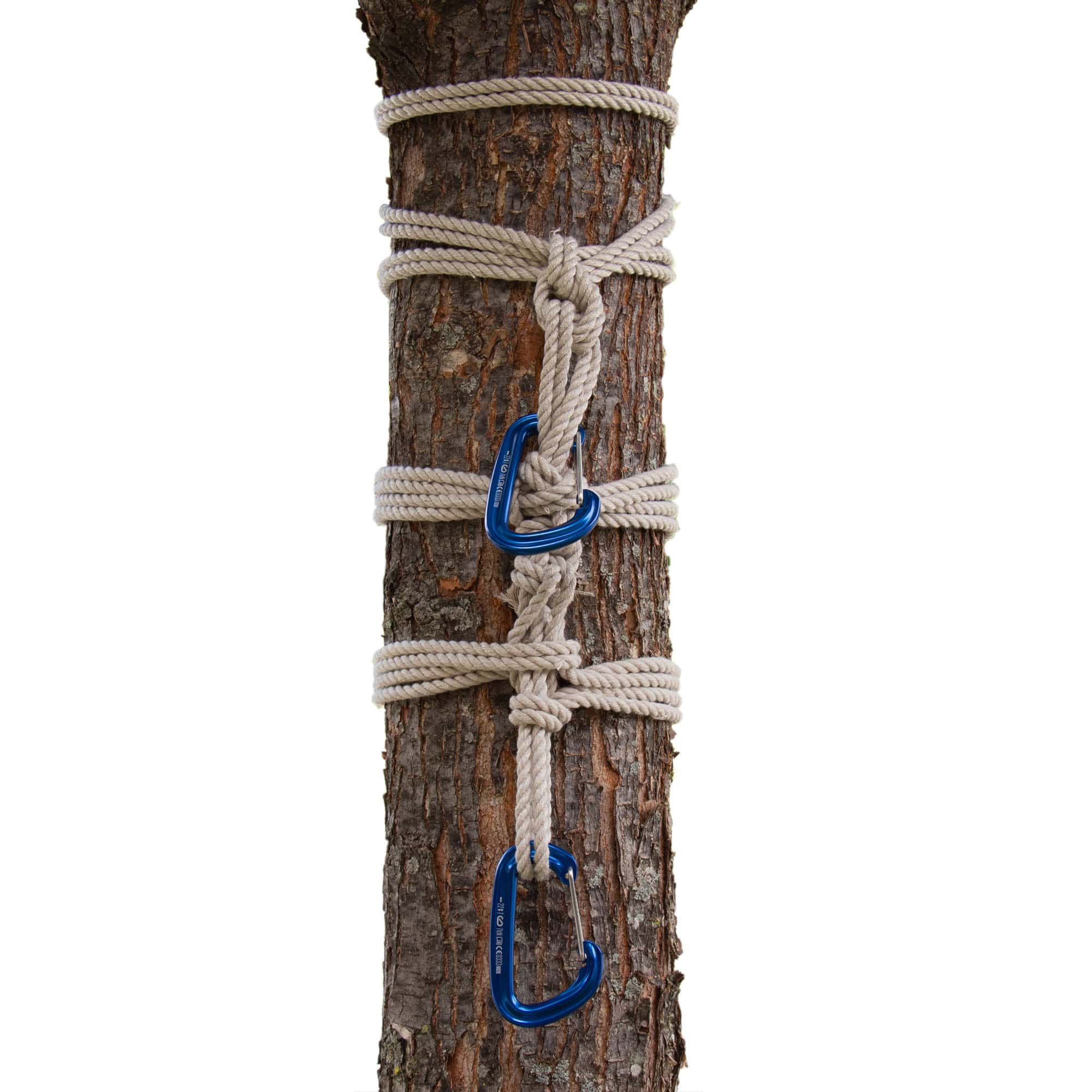
Hashira Anchor
How to tie a hard point to a vertical beam, tree, pole, etc...
How to tie an Hashira Hard Point or Anchor Point
Here are several techniques on how to connect rope to a vertical beam (a post, a pole, a tree, etc.) so that it grips tightly and will not slip down. This allows you to create an anchor point for floor work, or partial or full suspensions in places that you would otherwise not be able to do so. So adding this skill to your toolbox gives you more options!
IMPORTANT: This tutorial is meant as part of the Hashira series. Go read the Hashira Shibari tutorial as well before you try any of the below. That other tutorial contains critical information you need in order to reduce risk. Risk in bondage activities can never be fully eliminated. Educate yourself on those risks, plan and practice so as to reduce them. You are responsible for making your own risk-aware decisions.
The key to a good anchor—one that will not slip down the pole when under load—is the friction between the rope and the beam. The two things govern that friction:
- The relative roughness or slipperiness of the beam or pole itself
- The tension in the rope gripping the beam
A wooden beam or a tree are both relatively rough; rope can grip them quite easily. Whereas a piece of bamboo or a painted steel pole are very slippery and rope must be put under tremendous tension in order to effectively grip them.
A few important safety factors:
- Use techniques with multiple support mechanisms I personally like to have at least two elements gripping a pole and providing support for my anchors. This is where I bring in the Klemheist Hitch. Combining these factors adds safety. Shit happens. Failures happen. You *will* at some stage in your rigging career have an accident or have something fail on you. An important rule is, “Always be more than one failure away from disaster”
- Use newer rope With that in mind, many riggers will only do this type of anchor using a newer rope. As a rope is used over time, it becomes more and more broken-in. While this means that it is softer and more sensual against the skin, it also means that internal fibers have literally been broken … and therefore the rope is not as strong as it was when new. So: another safety factor is to use newer ropes in situations that require extra tension. This is especially important for beams that don’t have smoothed or rounded corners. Beams with sharer corners will put a tremendous amount of pressure on your rope.
- Never tie on a beam with sharp corners Beams with sharper corners—an I-Beam for example—put tremendous pressure on your rope. Under load, this pressure can be so strong that your ropes may be cut by the shearing forces involved. Find beams with rounded corners, or rounded poles, trees, etc.
Creating a hard point when you have a cross beam, angle brace, branch, etc...
If you have a horizontal beam, angle brace, etc connecting to your vertical beam, you can incorporate it into the creation of your anchor point. Doing so is a far less risky way to create a hard point than the Hashira Anchor below. (The view of some however is that the art and technical skill of Hashira practice lays in the purity of using just the vertical beam—and that to use any horizontal element means that it is no longer Hashira. Make of that what you will…)
This technique can serve two functions: (1) an anchor point itself and (2) the secondary anchor to add additional support to other vertical anchors that you add further down the pole as I show in the Klemheist example below
While I show this technique using rope, you can also do the same thing using tubular webbing and a water knot.
Creating a Hashira Anchor, a hard point on a vertical beam, pole, tree, etc... (no cross brace)
This is much riskier than the one that also uses a cross or angle beam … When the grip is only vertical, there is nothing to stop the anchor from sliding down if it is improperly tied. Hashira suspensions are considered by some to be one of the highest-risk types of rope bondage.
I recommend that the first few times you use this type of anchor, limit yourself to floor scenes and semi suspensions—scenes where your partner can support themselves if needed. Get a feel for how everything works and get some experience before trying a full suspension. I have a number of fun ideas below in the Hashira Shibari tutorial that you can use to build your skill.
This is risky, plan ahead, have fail-safes, always be more than 1 failure away from disaster
This Video Covers:
- Choosing a Vertical ... Thing (0:00)
- Tying the Hashira Anchor (2:05)
- Adding more anchor points (8:16)
Creating a hard point using a Klemheist Hitch and suspension lift loops
The Klemheist Hitch has tremendously strong grip. We can take advantage of that grip and combine it with speed and flexibility of a classic suspension lift loop to make an anchor able to grip almost any beam or pole. Using this technique, I have even successfully created a rock solid anchor on a polished stainless steel pole.
This Video Contains:
- Planning Considerations (0:00)
- The Klemheist Hitch (2:11)
- Creating a Suspension Lift Loop (4:30)
- Converting a single-bight lift loop to a double-bight variant (7:08)
- Combining the Klemheist with a lift loop to make a high-grip anchor (10:18)
- Adding multiple anchors so you can have an anchor stack, if desired (17:39)