
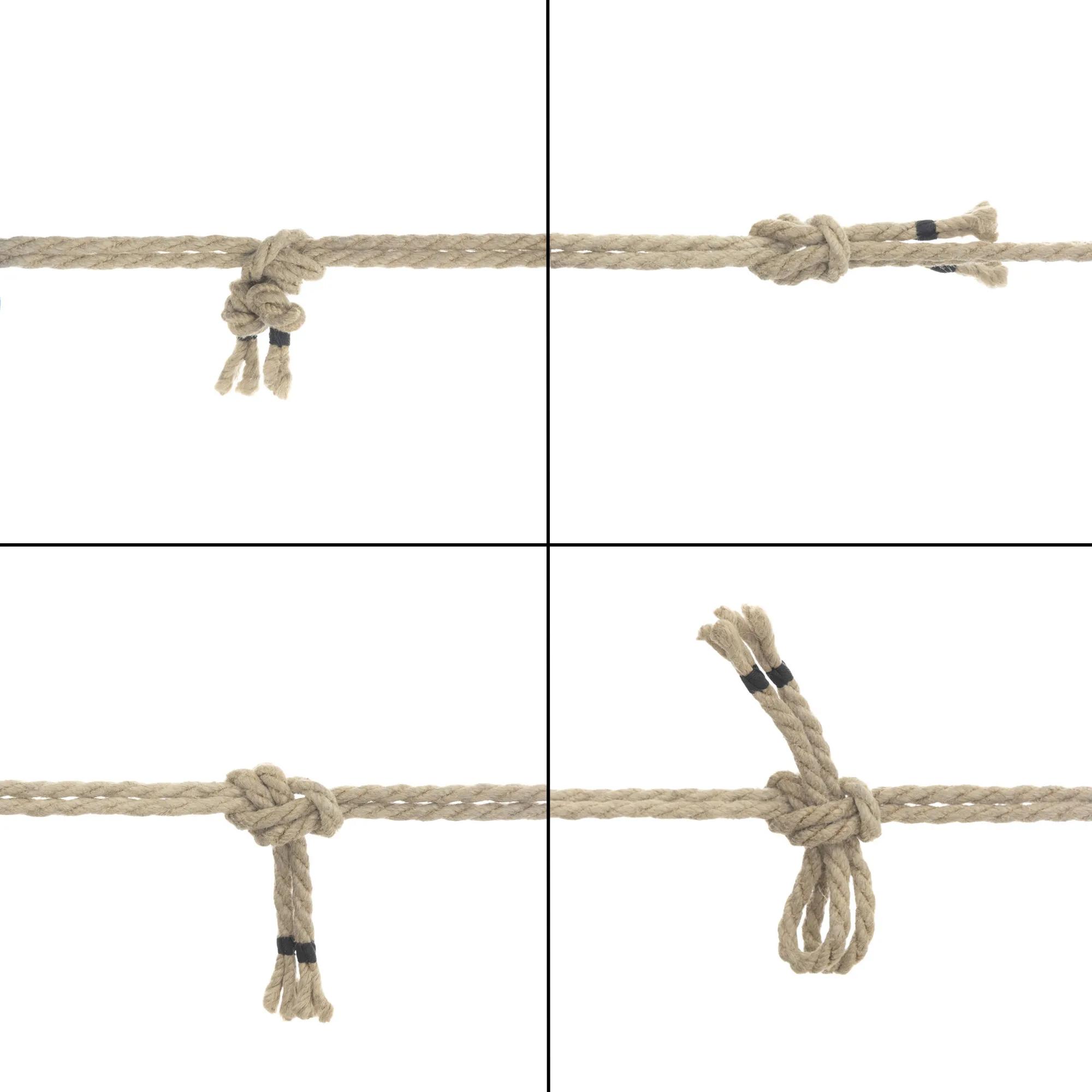
Extending Rope
Three way to add rope to your tie if you need a bit more...
Many riggers only carry ropes of common lengths like 30’ and 15’. These are useful for different purposes and are easy to handle. (More on this at Rope Lengths & Thicknesses.)
We do this because it saves us time when tying for a scene. Many common ties require you to pull the tail through multiple times. With shorter ropes, you can pull the tail through in 1-3 moves. But the longer your rope, the more moves (and more time) each tail pull will take.
However, there are many ties that require more than 30’ (9m) of rope—many chest and waist harnesses, for example. You will either need a very long rope, or… you can just learn how to extend your rope when you need more! Once you understand these simple techniques, there is no need to use extra-long ropes harnesses for most cases. (That said, some riggers still carry extra-long pieces for cases where they specifically want to have no rope joins, for example if doing some specialty rigging for a photo shoot.)
Here are several techniques that will allow you to simply extend your rope and continue.For this tutorial, I used Natural and Blue 6mm provided by my affiliate Twisted Monk.Check them out for some amazing hemp rope!When extending a rope during a scene, keep one hand on the prior rope, maintaining the tension, while you add the new rope. This keeps that connection with your partner alive. They continue to feel your attention during the pause. If you do this, you will need to prepare and add your new rope mostly using just one hand, so here is a useful technique to create a Lark's Head using only one hand.If the ends of your rope are knotted and are even, you can use this fast connection method. It is a bit bulky however, so you may want to use one of the techniques below anyway…If the ends of your rope are not knotted, you can still use a Lark’s Head … by “collapsing” it into a Square Knot! This technique is also helpful if the ends of your first rope are not even.
Cool Feature #1 - You can easily move the node
Cool Feature #2 - This works even if the ends are not even!
Using this technique in action...
This is another great technique that will work regardless of whether the ends of the prior rope are even or not. This one also works well even if the diameter of the rope is different (a rare circumstance in rope bondage, but it’s good to know how to deal with it nonetheless).There are many reasons why it can be helpful to be able to quickly untie your partner. Many of those reasons are covered in our article on Scene Negotiation & Planning. Here is another technique to build a quick-release into your bondage, with only one simple change:You can completely end the first rope (use up extra rope and then tie off the end), and then add a brand new rope to any line that is under tension, the stem for example, or a chest or waist strap.
Example:
Here we have completed a Hishi Karada, used up the extra rope and tied it off. Now we want to add a new rope so we can do something different around the hips.There are several ways to join a rope to a stem such that there are two strands leading out of the new node in both directions. An Overhand Knot or a Crossing Hitch, for example (not shown).
Here is another approach, using a Cored Square Knot, that happens to be one of my favorite for its attractively symmetrical and streamlined appearance, and ease of adjustability. You will need two ropesUse a Lark's Head to grab the old rope. This is a very fast way that you can use if the ends of your rope are knotted and even.
Using this technique in action...
If the ends of your rope are not knotted, you can still use a Lark’s Head … by “collapsing” it into a Square Knot! This technique is also helpful if the ends of your first rope are not even.
Using this technique in action...
You can also completely end the first rope (use up extra rope and then tie off the end), and then add a brand new rope to any line that is under tension, the stem for example, or a chest or waist strap.
In this example, we have completed a Hishi Karada, used up the extra rope and tied it off. Now we want to add a new rope so we can do something different around the hips.