
Hishi Karada ('Rope Dress')
By Lazarus Redmayne
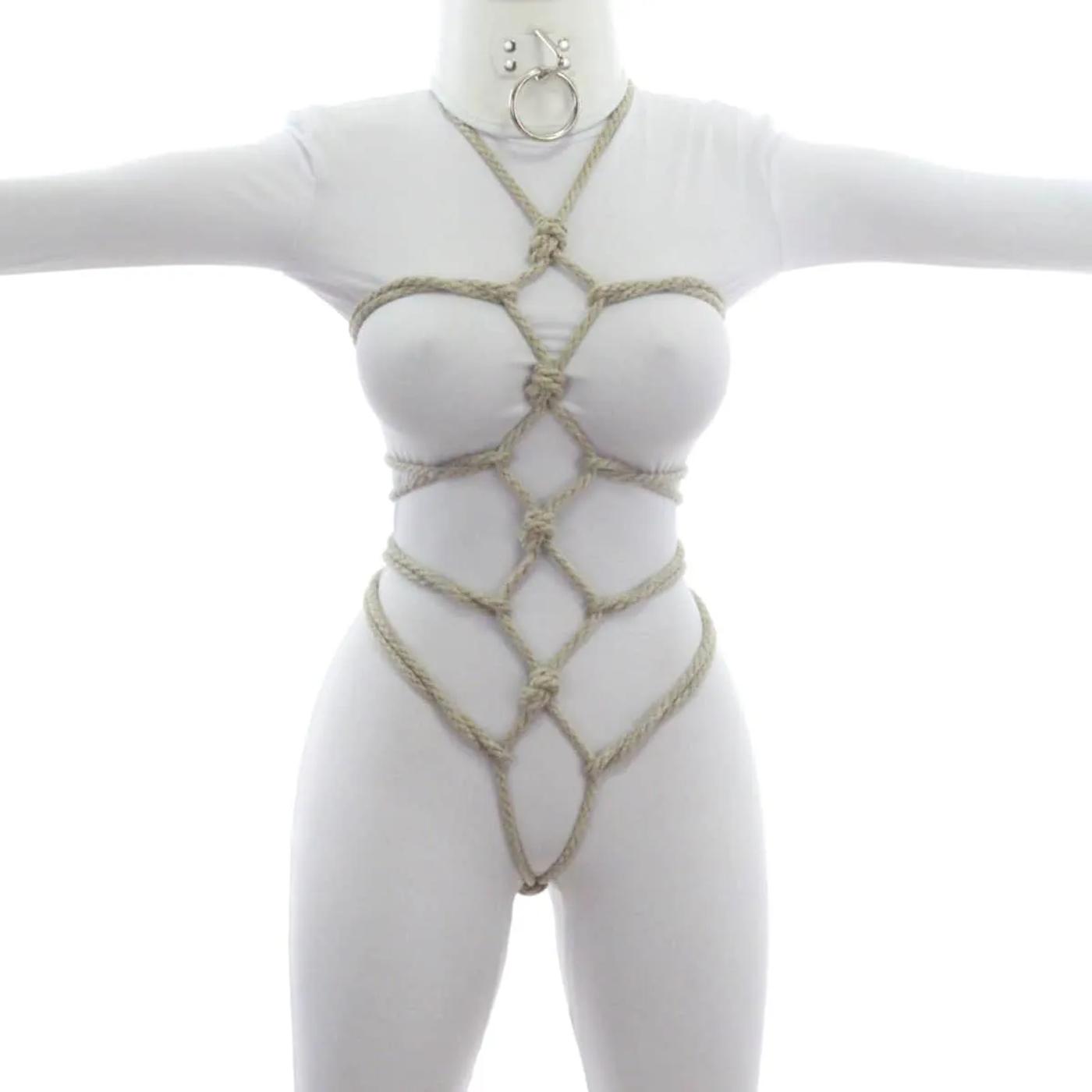
The Hishi (Diamond) Karada is sometime known simply as a “rope dress”. It is attractive and a great anchor for additional layers and ties. Its diamond patterns and tight lacing is lovely and stimulating for both parties. It can be worn for quite a long period and people have been known to wear them under clothes for a bit of surreptitious public bondage. This model is about 5'3" with a petite build. On her, I used about 30-35' of rope for this tie.
If interested, there is also a Full Body variation of this in the Behind-The-Scene (BTS) section!
Cool Features: This can be made quite tight, but keep in mind the warning below. When you take this off, it leaves beautiful rope marks for a little while. It also has a "happy knot" feature that can add a nice twist if you include a figure 8 knot or chain stitch.
Risk Management and Safety
Be sure to check our Safety page for important information about tight chest harnesses when combined with tight waist restraints. This has both, so make sure that your partner has no interference with his or her breathing.
Rope Needed
For this tie, I used one 30' (10m) piece of Natural 6mm (1/4") hemp provided by my affiliate Twisted Monk. Check them out for some amazing hemp rope!
Video - How to tie the Hishi Karada
Video Contents:
- The front (0:19)
- Options for between the legs (4:30)
- Lacing the back and sides (5:39)
- Adding rope (14:12)
- Using up rope (19:37)
Video - Connecting with your partner while tying the Hishi Karada
Pictures & Text
Start with a long rope folded over in the middle. You can either start with a simple bend in the rope with 1/2 the rope over each shoulder as I show or…
Put an overhand knot in the bight in the middle so that you have a small (1"/2.5cm) loop at the end as I show here. This is what I almost always do it because it adds a little bit more stability to the tie later off. Position this knot so that it is between the shoulder blades, about the level of the armpits
We're going to put an overhand knot on the front of our partner now at the same level as the overhand knot in the back
The knot should be just below the clavicle
We're going to tie a second overhand knot now, and it should go directly over top of the sternum or right at the midpoint of the breasts if your partner has breasts.
Now that we have the second knot, we can see the space saying that we need for the rest of the knots…
So we need to place our third knot the same distance from the second as the second was from the first...
Like this…
Place the fourth equidistant from the third. If your partner is tall or has a long torso you might need a fifth
(Optional) you can place a "happy knot" if you wish. This is an overhand knot, or figure eight knot, etc., positioned so that it places pressure on your partner's clit or perineum
One properly placed, a happy knot should be approximately like this on female body types...
Note: If you are going run rope so that it touches someones sexual organs or anus… WASH your damn rope afterwards. Alternatively, wrap a little plastic wrap around those parts of the rope that will make contact…
…And like this on male body types
Run the tail up your partner's back and through that small loop you formed in step 2
Separate the strands of the tail and began wrapping them around your partner's body
Bring them to the front and run them through their respective sides of the upper diamond
You're going to be pulling the strands back the way they came to separate the strands of the center line and thereby create this attractive diamond shape…
However before you do so, you can optionally add a little twist to where the rope runs through the diamonds. This adds additional friction and a decorative flair that I quite like. To do this, run your fingers underneath the incoming strand, hook the outgoing strand and pull through
When done your upper diamond should look like this
(Option 1) Bring the strands to your partner's back and cross them
(Option 2) If you wish, you can add an Overhand Knot here as well. I almost always do this because it does add some additional friction and additional stability to the tie, and it doesn't take much more time to do
(Option 3) you can add even more friction and stability by making that overhand knot grip the center line! To do this, bring one line over top of the centerline has shown…
…then lay the second line over top of the first
Place your fingers under the center line *and* underneath the first line, and then grab the second line
Pull the second line through and then continue wrapping both lines around your partner's body. You can now see we have an overhand overhead knot that is also wrapped around the center line. (End option 3)
Bring the lines to the front of your partner and through the second diamond
Add the decorative twist if you wish
It will look like this
Bring the lines to your partner's back again and again cross them using any of the three choices we discussed above
Bring those lines to your partner's front and through the third diamond
And again to your partners back, crossing them as you choose
(optional 4) Actually, at this stage I often like to use a "cored square knot" to connect this particular wrap to the center line. This option adds a bunch of additional friction and allows you to control where that knot lies and thereby where the rope itself lies. (This can help you to compensate for your partner's curves) To do this, take cord 1 and lay it over top of the center line…
Lay cord 2 and lay it over cord 1
Place your fingers behind the center line and cord 1 and grasp cord 2. Pull it through (not shown)
The rope I am holding is still cord one (you can see how it's the same one that is coming in from her right hand side). We are going to do exactly the same thing we did before: place cord 1 over top of the center line...
Place cord 2 over top of cord 1...
(Cord 2 was the one that going straight down)
Place your fingers above cord 1 then behind the center line and cord 1. Then grasp cord 2
Pull cord 2 through (not shown). Tighten it to complete the knot. You can slide this knot up and down the center line to better position the cords!
This is completed Hishi Karada, if you stop at this point.
Ending 1 - If you have a lot of rope left over, keep going...
If you have rope left, as I did, I like to use it up by adding yet another wrap around my partners body...
Bring the rope back around to the front and through the center line just as you did for the other diamond
Separate the strands, adding just enough tension to make this opening the same width as the other diamonds. Add your decorative twist, if you have been doing that...
Bring the cords to the back...
Bring it to the back again. Tie off. I also tend to use the "cored square knot" here again because I can adjust it higher or lower to help make the cord lay where I wish them to lay
Now I only have a little rope left and I will use it up by running behind all the lines…
There a many other ways to use it up, including wrapping it around the stem, or tying a series of Crossing Hitches, etc...
...and then tying an off near the top with the square knot
Completed Hishi Karada
Ending 2 - If you are almost out of rope, lock off and wrap the remainder
If you only have a tiny bit of rope leftover like I have here, you can simply tie it off to the center line with a Square Knot or a Cored Square Knot. Once the knot is tied you can tuck the ends under the incoming lines to get them out of the way
If your leftover is a little longer, but not enough to go to the front and back to the center again, you can use it up by wrapping it around the centerline going up your partner’s back. If you are satisfied with how the tie looks at this point, you are done; otherwise, you can add more rope and continue!
Ending 3 - If you ran out of rope, but want to keep going, add more!
If you run out of rope, you can easily add more. Because with this tie we are treating each strand individually, it is easier to add a new rope by connecting it to the vertical center line (also called the “stem”).
Run the bight of your new rope underneath the centerline
Reached through the bight to grab the tail
Pull the tail through and tighten the Lark’s Head onto the centerline, then grab one of the strands…
…and run it underneath the centerline to the other side
Pull both the ends to tighten the knot further and then continue tying your pattern
Comments
Loading comments...
Sign in to leave a comment.