
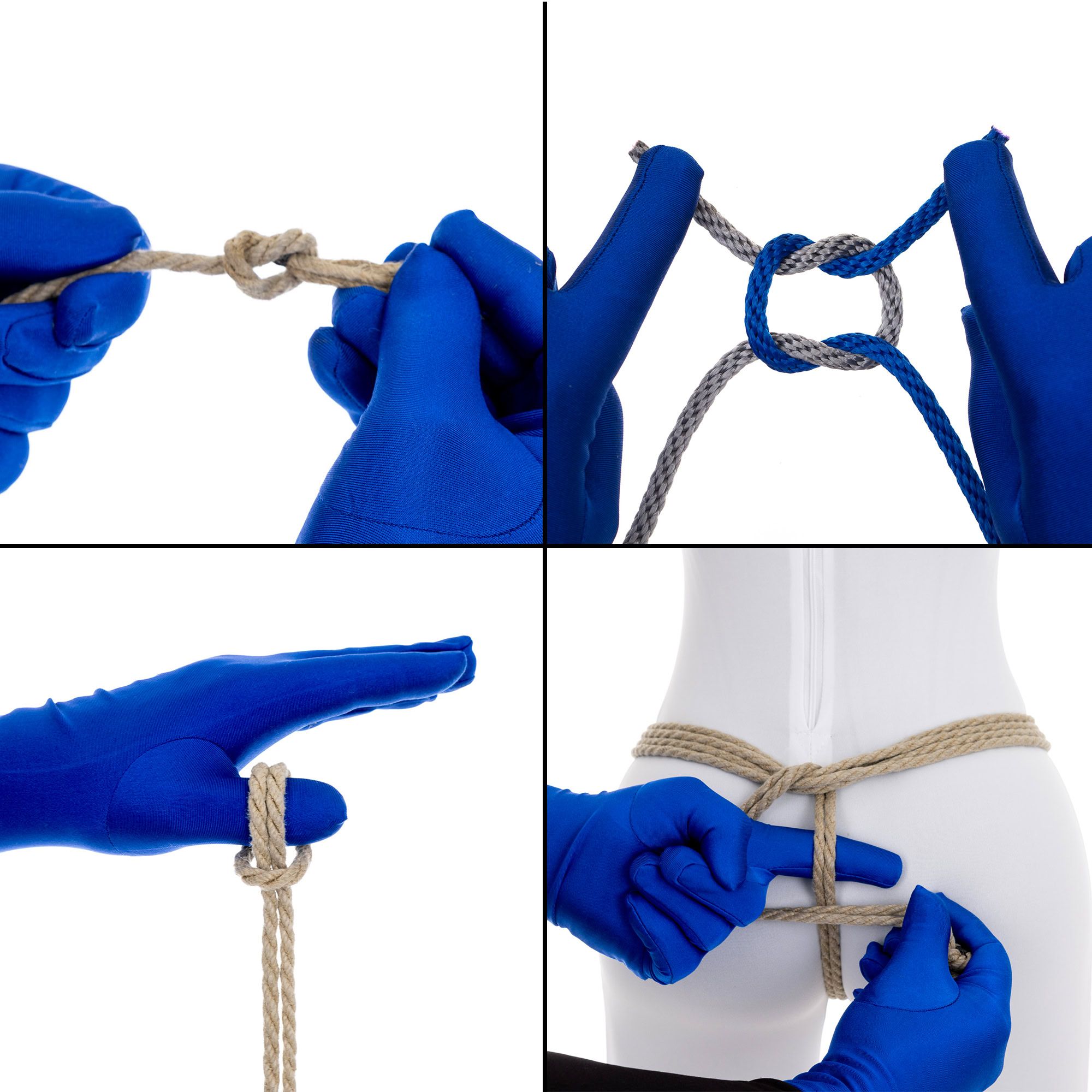
Master the 4 Fundamental Knots
These four knots are the fundamental building blocks of shibari. Understand these, then go on to use them to build core rope bondage techniques like the Single Column, Double Column and more.
I have a background in hard sciences and engineering, so it is no great surprise that I tend to see the world in those terms. Big, complicated things are just made up of smaller, simpler things, put together in clever ways. Shibari (rope bondage) is no different.
Those beautiful, complicated-looking ties you love are made up of simpler elements, which are, in turn, made of fundamental building blocks.
The 4 Fundamental Knots:
For me, these four knots are the fundamental building blocks of shibari:
You will use these all the time. Master them, practice them. Do them until your muscle memory is so strong you can tie them on autopilot.
Links to all of these will also be provided below, but before you jump to those tutorials to learn them, take a moment to read the rest of this article so you understand why I consider these 4 knots – along with techniques for good rope handling – to be the fundamental building blocks of shibari.
Take this scene for example:
It is made up of 8 ties:
- A chest harness called a Shinju.
- A waist harness called a Crotch Rope or Unchastity Belt.
- A Lark’s Head Double Column being used to Frog Tie one leg.
- Another Lark’s Head Double Column on the wrists that has been…
- …converted to a Load-bearing Lark’s Head Double Column by adding a new rope…
- …which is then anchored to something using an RTTHH.
- A Somerville Bowline Single Column on the ankle which is then…
- …anchored to something using and RTTHH.
But the cool thing is that each of those 8 elements is made up of smaller components that follow common patterns and eventually lead to the 4 Fundamental Knots. Let’s see how that plays out!
The first element, the Shinju…
…is made up of:
- A Larks’ Head Single Column around the middle of the chest.
- Another Larks’ Head Single Column (with a different starting step) around the upper chest.
- The rope run from the back to the front and…
- …connected into the straps using a Half Hitch (a fundamental knot), then run back of the shoulder and…
- …locked of in the back with another Half Hitch.
The second element, the Unchastity Belt (a.k.a Crotch Rope)…
…is made up of:
- A Larks’ Head Single Column around the hips
- Running the rope down between the legs
- Optionally using an Overhand Knot (a fundamental knot) to create a “Happy Knot” to tease your partner…
- …and locking off the rope to the back of the belt using Two Half Hitches (a fundamental knot).
The Larks’ Head Single Column…
…is a core component of both of those harnesses. It is created using:
- A Lark’s Head (a fundamental knot).
- Followed by a wrap or two of rope, then…
- …locked off with a Half Hitch (a fundamental knot).
Now we are down to just the Fundamental Knots and Rope Handling!
The third element, the Lark’s Head Double Column Frog Tie…
…is made up of:
- A Larks’ Head Single Column (a fundamental knot) around the ankles and thigh, followed by several more wraps of rope.
- Running the tail between the ankles and thigh to form a cinch, then
- (Not shown) locking off the tie using a Square Knot (a fundamental knot)
The fourth element, the tied hands…
- Start with a Larks’ Head Double Column (just as with the leg)
- Convert (1) to a Load-bearing Larks’ Head Double Column by adding a new rope using a Lark’s Head Knot (a fundamental knot) around the strands of the cinch of (1).
- Then run the tail of (2) to something immovable and…
- …anchor the rope to that item with Two Half Hitches or an RTTHH, both of which use Half Hitches (a fundamental knot) as the Lock Off.
The fifth element, the tied ankle…
- Start with a Somerville Bowline around the ankle. This is just a couple of wraps of rope secured in place with…
- …two Half Hitches arranged in a clever way to lock off the cuff.
- Then run the tail of (2) to something immovable and…
- …anchor the rope to that item with Two Half Hitches or an RTTHH, both of which use Half Hitches (a fundamental knot) as the lock off.
You can see how all of these ties are built using these 4 Fundamental Knots, connected with good rope handling!Go through these tutorials and practice these fundemental knots. Know them backward and forward. Mastering them now will save you much frustration in the future.
What I show above is a sample of what we do in the CAS section of TheDuchy, we create a scene using multiple and techniques, then annotate the completed picture so you know what ties we used and can look up how to tie each of them so you know how to re-create that scene.
We feel do this helps build your skill at reverse-engineering a tie when you see one. Understanding how something was built allows you to modify it to meet your needs. As you understand these building blocks, you will become better able to look at a scene and understand how it was done on your own. Even better, you will be able to understand what you might have done differently and why!
This all begins with the fundamental building blocks.Use these 4 Fundamental Knots to create a few core column ties like the Lark’s Head Single Column and Lark’s Head Double Column. Then learn how to smoothly and competently Handle Rope While Tying. Find all of this laid out for you in order in our free Foundations of Rope / Rope 101 Course.