
Imbricated Outfit Toolkit
By Lazarus Redmayne
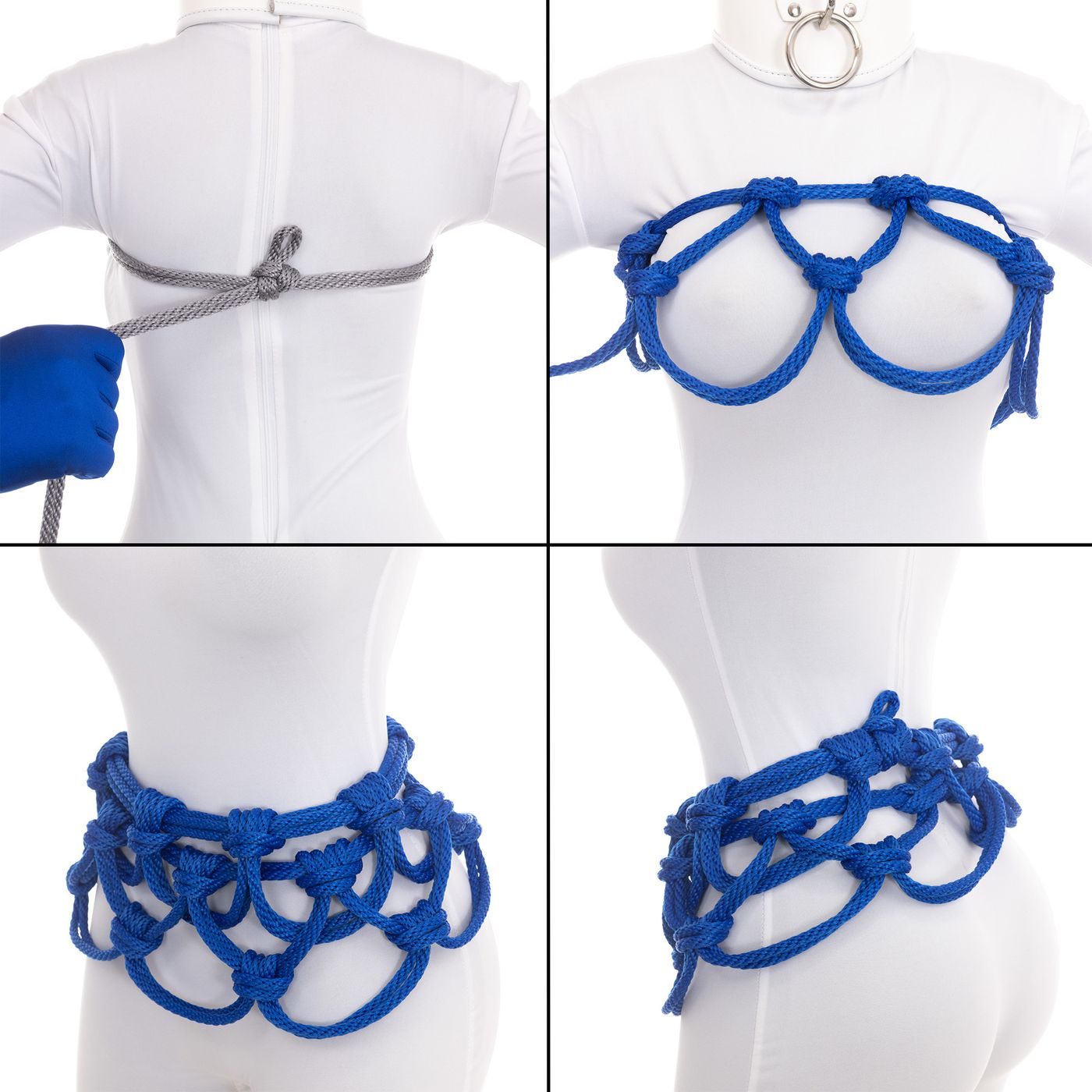
This is the Imbricated Outfit Toolkit. It is more of a mini-course than a tutorial. It is a set of techniques that you can mix and match to create your own designs! So read through the whole thing before you pick up rope and decide what you want to try! Also, this is set as intermediate not because the techniques are difficult, but because they take patience and consistency to make look good. Good rope handling technique should be second nature to you before trying this.
This tutorial was inspired by an amazing design, called ‘Tidefall’, developed by GodlyMana [FL][IG]. You can see his original post on FetLife or below. He and I met when I was out in Detroit, teaching at Oblige Rope Studio. It was a great weekend, teaching in an incredible space. If you are out there, I highly recommend a trip to Oblige!
Back to the dress! I immediately reached out to GodlyMana to discuss creating a tutorial on it. I reworked some of his original ideas into a modular approach that provides a variety of patterns that you can mix and match to create endless designs. I also include a way that you can make the outfit quick to untie and even reuseable! This can be immensely helpful, as it can take quite a bit of time to tie a outfit like this, depending on what you choose to do. I created an entire separate tutorial using the techniques below to reproduce Tidefall, but before you jump there, finish this tutorial, because with this tool kit…
There are so many creative options. You can vary…
- What you create: Just a top, just a skirt, both, leggings, a full-length design or more
- How many rows/layers it will have
- Which method you will use to add new rows (if it will have its own, independent anchor/frame line or be connected to the prior layer)
- If you interweave one row with another (and if you do so with just one element or more than one)
- What size of element you choose for each row
- The size of each element within a given row…
- All elements the same size (like scales)
- Smaller to larger to smaller again …
- Alternating sizes …
- Larger on the outside with one smaller one in the middle
- …others
- The color, diameter and length of rope you use
- Many. Options!
…let your creativity ignite!
These techniques make heavy use of the Cow Hitch, each of which takes 3 tail pulls. Therefore, making something with this toolkit will take some time. The time will increase with the number of layers you decide to do or if you use longer ropes, but the results can be worth it.
“Imbricated?”
‘Imbricated’ is a general term for repeating overlapping patterns. Like fish scales, a repeating scalloped pattern, layers of bunting laying on top of each other, and other such ideas. Pretty much exactly what we are doing here!
Time-saving note for experienced riggers:
This is just a creative application of a whole bunch of Cow Hitches. The important new parts for you will be:
- The technique to make these outfits quick-release
- These inspo pictures for various draping patterns
- The various ways to add more rows
- This cool trick for working with very long ropes, if you choose to do so
Working with very long ropes
Attractive patterns like this are often fun choices when doing rope for photo shoots. In such cases, it is common to want the fewest joins possible and therefore to use long ropes.
- The problem: Imagine how much time it would take to do 3 tail pulls for every Cow Hitch when you start with a 120’ (~36m) rope! (That’s how long the rope was I used for the skirt in ‘Tidefall’!)
- The solution: I made up an extremely helpful technique to allow you to use long ropes without adding a huge amount of time to the tying processes. Check out to the ‘Tidefall’ tutorial for the trick!
Rope Needed
The amount of rope you consume depends on the build of your partner and on what patterns you choose to tie, but to give you an idea, here are some stats for rope consumption on Natasha, who is quite small -- 4’9”, 36-23-40 | 146cm, 80-51-88:
It took one 30’ (~9m) rope to make the top you see in the featured image, and two more to make the skirt.
The Inspiration
This inspiring design was developed by GodlyMana. Find more of his wonderfully creative work on FetLife and Instagram!
Video
Forthcoming -- I did shoot video footage on this, but it is not yet complete. This was a monster of a tutorial! I wanted to get the pictures+text version out there for some people that have been asking for it and didn't want to delay releasing this while finishing the video.
Start With A quick-release frame
Tying with Cow Hitches takes time, but if you plan ahead, untying can be very fast! These framing/anchor lines will be the cores around which the Cow Hitches are tied, so if you design your framing so it can be released without untying the whole outfit, you can just pull those lines out of the inside of the Cow Hitches, which – as you can see here – then just fall apart! Very cool.
Important! … Use a rope that does *not* have knots at the end.
Note: With the exception of the last technique shown below in this section, these are all focused on establishing the anchor line for the first layer of a garment. Techniques for adding additional layers are shown in the Adding Layers section below.
Core technique and the secret to make this quick-release!
This is good for a top with no shoulder straps, or for the hips. You can use almost any strap pattern you like, the key is to start it differently!
Normally, if you want to make a single-wrap line, you would likely do something like this:
Normally, if you wanted a line around the upper chest you would place the line where you want it, then…
…run the tail through the bight to create a Lark’s Head…
…then lock if off with a Half Hitch
The problem with this is that you need to fully release the tail in order to untie this wrap, and if I go on to use this tail to create the rest of my tie, I would have to untie all of that to release this tail.
But with one cool variation, you can make this quick-release!
Run the line around the body where you want it to be, but this time, don’t run the tail through the bight. Instead…
Form a secondary bight with the tail.
Run the primary bight up through that secondary bight so that ~3 inches (~8cm) Goes through. Note that the primary bight should be moving in the upward direction.
Hold that in place, while you run the bight end behind the wrap…
(… you may then have to adjust things so you have a little room…)
…then run the bight back up around the lines of the Secondary bight, forming a Half Hitch that holds the secondary bight in place.
This knot is called a Sheet Bend.
To tighten the wrap and the knot, first pull slack out of the wrap by pulling on the secondary bight, then…
…pull the tail through the Half Hitch…
…to capture and remove that slack.
Now you have a first wrap that can be released just by untying that Half Hitch. You will see how useful this is in “Using the quick-release feature”, below.
Now you can take this tail and either (1) add a second wrap, (2) add a second framing line, or (3) begin adding your imbricated pattern … all of which I show below.
Adding a second wrap to make it a Double Wrap Frame
This is useful when supporting heavier ties, when wanting to distribute force over a larger area, or just for the aesthetics. I will show this one on the hips.
Complete the single wrap technique above.
Add a second wrap.
Temporarily removed the bight from the Half Hitch.
Run that bight behind the new wrap…
…and then reestablish the Half Hitch.
Adjust the tightness and you’re ready to go!
Adding a second wrap to make two separate frame lines, spaced closely together
This is useful when you plan to have two rows of imbricated patterns that you want to interact to form a scaled or interwoven pattern.
Complete the single wrap technique above.
Add a second wrap, this time placing it’s a little ways away from the first.
You can lock it has shown in the “Double Wrap Frame” technique above or … you can just bring it up through the secondary bight like this…
…then begin adding your Cow Hitch pattern.
Frame with shoulder straps, giving 2 points of support
This can just be a design choice, but it can also help better support larger, heavier designs.
Start with the Core Quick-Release Technique above, the you can immediately begin adding shoulder straps by running the tail up toward the shoulder, or…
(Optional) … If, as is often the case, you plan to have a second wrap so that you have two layers of scales, you can add that second wrap now…
…then run the tail under itself…
…then run the tail up toward the shoulder.
Either way, now bring the tail over the shoulder to the middle of the top line.
Connect to this top wrap however you like. There are many options, but as you will be using Cow Hitch everywhere else, that can be an excellent choice that will complement the overall design.
Bring the tail over the opposite shoulder…
… to the node at the back.
If you are almost out of rope…
…just lock off at this point. Then begin creating the first layer of your pattern with a different rope. (See “Adding a New Rope…” below)
If you have lots of rope left…
…add a Crossing Hitch (with the first tail pull toward the inside of the body)…
…to connect to the tail to the strap and begin making the first layer of your pattern!
Frame with shoulder straps, giving 3 points of support
This can also just be a design choice, but it also provides even more support.
This begins the same as the 2-point variant above.
This time bring the line over the shoulder, then straight down.
Connect to the top line with a Cow Hitch (or whatever other kind of connection you like). If using a Cow Hitch, do your first tail pull toward the outside of the body.
Complete the Cow Hitch.
Run the tail up around the back of the neck, then straight down again.
Connect to the top line with a second Cow Hitch. (This time doing the first tail pull toward the inside of the body.)
Run the tail up and over the shoulder.
In the back, bring the tail to the node and secure it with a Crossing Hitch.
If you have enough rope, you can begin creating your imbricated pattern right from here.
Different approach: Use a separate rope.
You can also create a multi-layer, quickly release frame using a different rope (useful if you want to use a different color for the frame.) I teach this in more detail in the “Building Blocks - Simple Strap Nodes” tutorial, so here are the highlights. Build upwards! Make your first wrap with a Lark’s Head.
Start with the single-wrap quick release frame technique above.
Using Option 2 from “Building Blocks – Simple Strap Nodes”, add additional wraps at whatever spacing you like.
(Optional) add shoulder straps (again, use whatever pattern strikes your fancy).
Lock off and use up any remaining rope…
...
…
This approach will also allow for a quick release of the imbricated outfit, because you can just untie the tail here…
…or here … and the pull this rope (which will be the core around which the Cow Hitches are all tied) out of the Cow Hitches, at which point they will all just fall apart!
Technically, you can start this frame with a Lark’s Head like we usually do…
…
…
…as long as you lock off this tail before adding any of the Imbricated patterns, this will still be a Quick-Release!
If you need to add a new rope to a frame line
A quick aside before we begin the main event:
If you need to add a new rope to a frame line, lay the bight on top of the line.
Bring the bight behind the frame line.
Pull the tail through the bight to form a Lark’s Head.
If you want this connection to look more like how a Cow Hitch, turn it into a Prusik Head. To do this, pull the bight out…
…continue wrapping it around the frame line in the same direction it was going…
…
…then run the tail through the bight a second time.
Tighten. This is a Prusik Head.
Here you can see a Cow Hitch next to a Prusik Head. You can see how they rhyme.
Row 1 - The core draping pattern … consistency is key!
For the rest of this tutorial, we will start with the basic single-wrap quick-release frame.
You can use the tail remaining after completing your frame,
It usually looks nice to make a drape be the same width and height. So as this drape is 3 fingers down…
…I will make it 4 fingers wide as well.
This size works well on this model. If your partner is a different build or if you want a more dramatic drape, you will make different sizing choices.
Put your first Cow Hitch here. Tying this outfit will go much more quickly and will look much better if you tie your Cow Hitches consistently and using good technique. Let’s go over that to make sure we are all on the same page:
Keep your lines in order as they come from the prior knot. Keep them parallel and not twisted. Lay the tail on top of what you are tying it to and clip it in place with one hand.
Once my Cow Hitch use complete, this line will be one of the two that are inside of the Cow Hitch (you’ll be able to better see that in a moment) For consistency, I am always going to have these ‘inner’ lines lay on top of the outer lines when doing the draping. Just stick with me for a moment and this will become more clear.
Hold the node in place with one hand while you run your finger under the line and hook the tail.
Pull the tail through…
…
This is the first half of the Cow Hitch. Make sure the lines stay in order and don’t twist.
Lay the tail on top of itself. Note that the outside line is above the inside line here in this horizontal section.
Hold that in place while you reach behind the frame line and hook the tail.
Pull the tail up behind the frame line…
I’m going to let go of the knot for a moment to point out something important: Note how the line that was on the outside on the right-hand side of the knot is again on the outside here on the left-hand side of the knot.
(I’m grabbing the knot again to keep it stable while I pulled the tail through behind the frame.)
…
If this is a long tail pull, you can hook the tail with your pinkie like this to keep the tail from flailing around and possibly whipping your partner.
Once the tail is fully pulled through…
You need the tail to come back down through here.
Reach through and grab the tail.
Pull the tail through.
It can be helpful to grip this point to keep it the loop open while you’re doing the tail pull.
Complete the tail pull.
Tighten.
You can then continue on to make the next Cow Hitch.
Before we do that, take a close look at this one. Note how clean it looks.
Note how the outside two line coming out of the knot naturally fall behind the inside two lines.
Note how the horizontal rope that connects the outside two wraps lays above the horizontal portion that connects the inside to wraps.
This arrangement allows for the tightest Cow Hitch with the greatest grip on the anchor line. Coincidentally it’s also the most attractive.
Again, we’re going for consistency, so once the knot is created and dressed, take a moment to double check its placement. In this example, I wanted something 3 fingers wide by…
…3 fingers tall.
Now repeat that pattern around the rest of this layer.
If you make the Cow Hitch the same way every time, eventually you’ll start to be able to do so very quickly and very consistently.
You don’t have to make your Cow Hitch is be the same size every time. You could make other artistic choices like this.
But for purposes of this example, I’m going to make them the same all the way around…
…
…
…
Once you have completed the first row, there are several options for adding more rows!
So. Many. Variations. (Lots of ways to lay down elements to create stunning patterns)
Patterns always look best when it is clear they are intentional. So, either make all the elements consistent or very purposely make them different, following some pattern. Perhaps they are all the same, perhaps they are different but follow a regular pattern, perhaps you go for radial symmetry. Here are a few ideas to get you started:
Within a single row:
You can keep the drapes regular.
You can make the Cow Hitches closer together for a longer drape.
You can make them grow larger, then smaller.
You can alternate sizes.
You can make strategic choices.
You can mix and match.
Double the rows, double the options:
Add an emphasis line without any drapes.
Make two rows spaced apart…
Close together…
Overlapping…
Or even interwoven…
Row 2+, Option 1 – Add a new frame line
Bring the tail down to where you want the next anchor line. This can be spaced farther away from the line above it…
…or quite close to it. Let’s place this one here so there will be some overlap with the layer above it.
Continue in the direction you were moving (in my case from right to left) and run the tail around your partner and bring it back to the starting point.
Attach it to itself with … you guessed it … a Cow Hitch! Go over the outgoing line and do the first tail pull on the upper side of the knot, then lay the tail on top of itself…
…and complete the Cow Hitch.
We do this to maintain the pattern and to make sure the quick-release feature will work.
Now continue moving in the same direction you have been and add the next Cow Hitch.
Confirm it is consistent with Row 1. Here I am confirming it is 3 fingers high, and…
(…or make a completely different creative choice. But make it a choice, not an accident!)
…3 fingers wide.
Continue the pattern to complete the next row.
Row 2+, Option 2 – No new anchor line. Attach to the bottoms of the previous row instead.
Cow hitches use up rope at different rate for the inside track and outside track. So when you switch rows, this is a great time to switch which strand is inside or outside. This way your tails will be close to the same length at the end. So I am going to grab my strands, then…
…flip my hand so the outside, becomes the inside.
It looks very natural to make this switch at this point.
Now continue in the direction you were going, but make the next drape longer…
…so you can attach to the bottom of the prior layer.
Then continue the pattern from there, matching the drape of the prior Cow Hitch.
Like this.
Here I am adjusting how much rope I use so that my drape remains at the same level while accounting for my partner’s anatomy.
…
… doing this allows me to emphasize -- or de-emphasize -- aspects of my partner.
Continue as long as you want…
Row 2+, Option 3 – Do not add a new line & double back
Choose this approach if you want to make the garment reusable!
This is almost the same as above, but you double back each time you get to the spine instead of continuing in the same direction. It results in a different look.
Change direction, but make the next drape longer…
…so you can attach to the bottom of the prior layer.
Again, I took the opportunity when changing rose to make the inside line…
…become the outside line.
Then continue the pattern from there.
Pay attention to how the bottoms of your drapes align.
…
…
If you run out of rope, simply…
… add more!
I find that using the Lark’s Head technique works well.
If one and is a little longer than the other, you can write back words along the pattern you have been making…
… Lock to get into a prior node to hide it.
Then continue on…
…
When you get back to the spine, double check the bottoms of your drapes to make sure they look symmetrical.
If you are almost out of rope, You can run the line back up to the staring point so that it mirrors the one on the other side. If you want to keep going, do so but I again reverse direction instead of crossing over the spine. You can see that in more detail in the “Making the Garment Reusable” section below.
Example 1 – A flirty skirt!
Let’s use the concepts above to custom-design a flirty skirt!
Artist's Corner
Using the quick-release feature (a demonstration)
Now for the magic, demonstrated using the skirt above!
If you untie this Half Hitch, the bight end becomes free…
…
…
… This means you can simply pull it out of the Cow Hitches.
If you created a Double Wrap frame, you will need to pull out the first wrap first and won’t notice much change, but…
…when you start pulling up the second wrap…
…you’ll start to see the Cow Hitches fall apart!
You can pull the core out of multiple Cow Hitches at the same time, as long as they are in a straight line. (The more slippery your rope, the more you can pull it one time.)
Without their core, there is nothing to hold them together.
…
…
Just continue pulling and the whole garment will quickly fall away. ; )
Example 2 – The pattern that makes this reuseable (tie-once-wear-many!)
This picks up where “Row 2+, Option 3…” above leaves off, so go do that first.
Complete the steps in “Row 2+, Option 3” above.
Reversed tension and begin adding the next row using the same technique…
…
…
…
Every time you get back to the spine…
… Reversed tension and added a new row going the opposite direction…
…
…
…
…
When you run out of rope, use it up however it makes sense.
In this case, as I have so little left, I will just use it up with Half Hitch.
Thus
Artist's Corner
Removeable
Because we have not crossed over the spying at any place other than this Quick-Release feature, we can release it…
…
…
…
…
…
And the whole garment can be removed…
…
…
…
…and carefully stored somewhere else until you want to use it again.
Putting it back on
Put it back in position.
Hold of the secondary bight in position.
Feed the primary bight through the secondary bight, going upwards.
Hold the secondary bight in position again while you reestablish the Half Hitch…
…
…
Boom!
The government will almost certainly need to be adjusted after being put back on. You’ll need to make sure the lines are laying but the way they’re supposed to.
You may need to adjust the position of some of the Cow Hitches.
Some of the Cow Hitches may have become malformed and need to be dressed again to look good…
…
…
But with very little work, it’s ready to go again!
Away to the party!
Quick Untie
When off, the rapid untie feature still works just fine...
Example 3 – ‘Tidefall’ by GodlyMana
In the ‘Tidefall’ tutorial, I use the techniques from above to replicate this very cool design by GodlyMana. Here are a few sample shots. For more detail, check out the full tutorial!
Comments
Loading comments...
Sign in to leave a comment.