
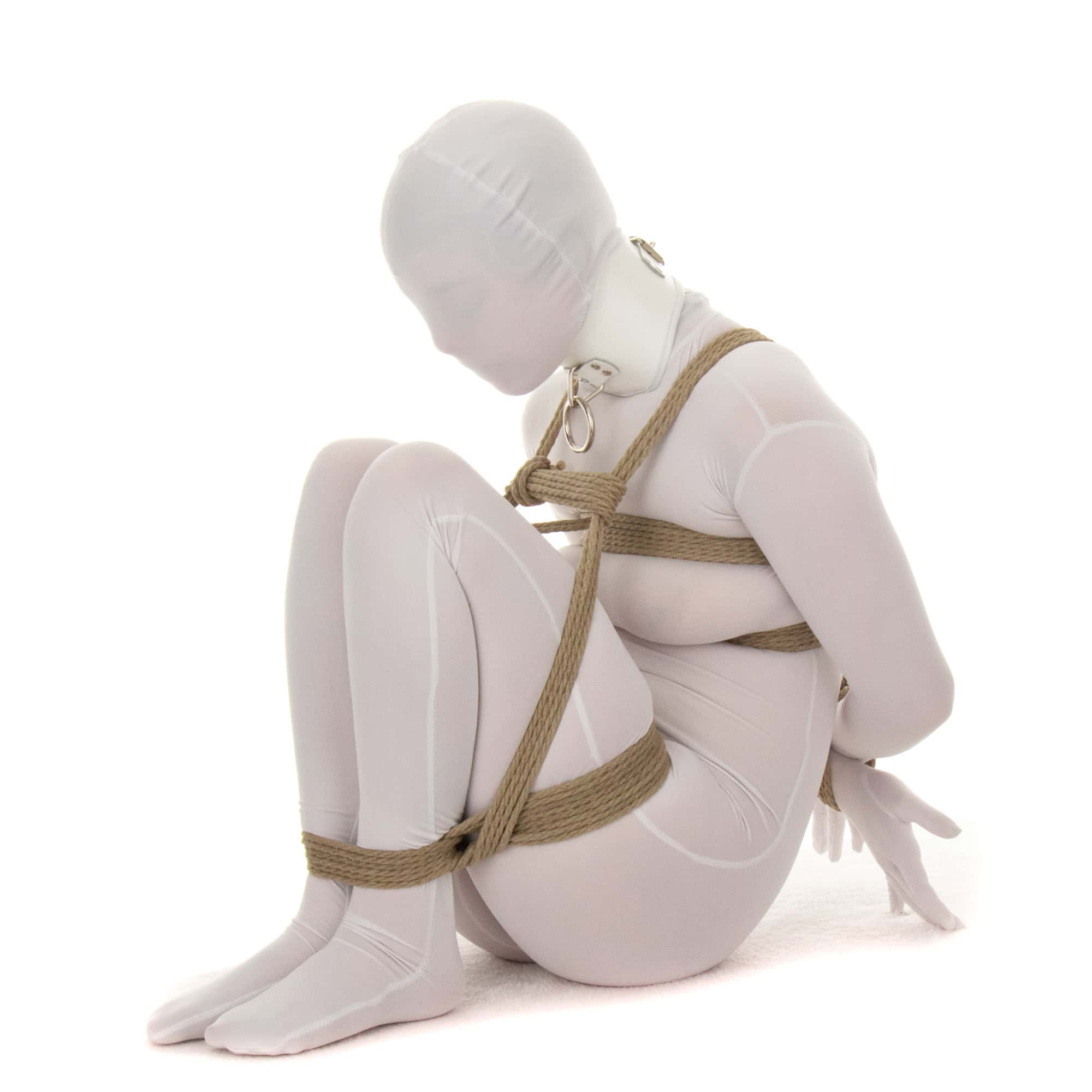
Ball Ties - Example 1
This is one simple way to tie your partner into a helpless ball!
There are *many* ways to tie your partner into a ball. We will discuss more in a future, more comprehensive tutorial on Ball Ties, which will cover their many options and variations. In the meantime, this tutorial will show you one possible way to tie your partner into a ball using nothing but simple Single Columns and Double Columns. We also include a few fun variations for positioning the arms and wrists.
This version doesn’t tie your partner’s arms to their sides--options to do that will be discussed in the future Ball Ties tutorial—but it still leaves your partner in a very compromised and helpless position.
Ball Ties Safety
- Risk of Positional Asphyxiation
- - In this tutorial, I show the tie as being quite tight to demonstrate how restrictive it can be. However, having it this tight would be too strict for many people. There are two factors here that need to be managed. (1) The chest strap, while not overly tight, still restricts chest movement somewhat. (2) The curled-up position of the body, a position that restricts the movement of the subjects abdominal muscles. If both of these factors are too strict (tight), it can make breathing difficult. Start easy. Don’t make either strap of the chest harness too tight (it should be a gentle hug) and make the ball much looser when you first try this. Test what your partner can safely handle and build intensity over time. Be sure to keep clear communication and, if they report any trouble breathing, immediately release the strap that cinches them into a ball (Layer 4 below). The rest can wait. That is the one to untie first.
- Risk of Injury (Arms)
- – This tie can be incredibly restrictive. So much so that the subject can be made almost entirely unable to move themselves in any substantial way. This means that, if their arms are tied around their legs and they are then tipped on their side, they will be laying on that arm and be helpless to move themselves off it. This can lead to unwanted pain or injury if left too long. If you find your scene has gone in this direction, the top needs to move your partner into different positions periodically to reduce this impact.
- Risk of Injury (Back)
- – This position can put stress on the back. If left in this position too long, your partner may experience strain or stress to the muscles or other soft tissue in their back. Limit the amount of time your partner is in this position until you understand their tolerances. Keep clear communication. Don’t push too far, too fast.
- Risk of Injury (Neck)
- – This risk applies more to a variant that you may have seen pictures of online. In that variant, the Layer 4 rope (the one that actually holds them in a ball) runs around the back of the neck instead of over the shoulders. We do not show that variant as we consider it too risky. In this position, rope run across the back of the neck may be pulled too tightly and/or remain tight for too long. Doing so runs the risk of moving the cervical vertebrae in a way that can cause pain or injury. We do not recommend this variation.
For this tutorial, I used three 30' (~9m) and two 15' (~5m) pieces of Natural 1/4" (6mm) hempI use an amazing Natural hemp rope provided by my affiliate Twisted Monk. Check them out!Prerequisites:Seated, Version 2. The wrists are not is a good position here (see Layer 5 or more on this), but the model is in a much tighter ball in this version. This demonstrates how restrictive this tie can be.The two primary ways to force a person into a ball are (1) run ropes over their shoulders to a point on the back and then use those ropes to force them forward into a ball or (2) run a rope around the back of their neck for that same purpose. Option 2 is very risky and we do not recommend it (see the safety notes above) and therefore we are not going to show it. We are going to do this tie with option 1.
Add some sort of chest harness to your partner. You can use almost any chest harness you like and you can decide to tie your partner’s wrists into that harness now, or later. In this example, we are going to go with a simple variation of the Shinju and add the wrists later. Other good options would be the Bikini Harness with the same modification we use below, or the 2-rope version of Gote Shibari/TK, which would trap the wrists here in this first layer. You could even just go with a single strap by tying a Single Column around the middle of your partner’s chest, at the sternum level, as long as it cannot slide up – this will be dictated by the build of your partner.You can tie the ankles in different ways depending on what you want to do next. Here are two good possibilities:
- Use one long rope. Start with a Single Column around the ankles, then (in Layer 3) connect the ankles to the upper thighs using the tail of the Single Column. This is the one we will show below.
- Use two short ropes. Use one to add a Double Column around the ankles, then add a second one to strap the ankles to the upper thighs. This one can help ensure that there is space between the ankles so that the ankle bones don't collide.
IMPORTANT: Tie the ankles a little loosely. Things tighten up when you add Layers 4 and 5, so you need some extra room at this layer, or you will end up pressing your partner’s ankle bones together in a very uncomfortable way.
So, choosing option 1:Now we need to connect the ankles to our partner in such a way that it keeps the legs folded. There are several good ways to do this. Either use the tail from the ankle cuffs or add a new rope, then:Now we need to connect the ankles to our partner in such a way that it keeps the legs folded. There are several good ways to do this. Two main categories are:Now that the ankles are secured to the upper thighs, it’s time to fold the body into a ball. There are a number of ways to do this as well, but this approach allows you to have a fine degree of control as to how tight the ball is going to be.
Safety – This strap is the key to how strict this tie will be. If your partner expresses any stress, loosen or release this strap first. That should quickly alleviate most issues.Now that the ankles are secured to the upper thighs, it’s time to fold the body into a ball. There are a number of ways to do this as well, but this approach allows you to have a fine degree of control as to how tight the ball is going to be.
Safety – This strap is the key to how strict this tie will be. If your partner expresses any stress, loosen or release this strap first. That should quickly alleviate most issues.If you did not tie their wrists as part of layer one, now is the time!
You have a variety of options.
Behind their back - Single Column
Behind their back - Two Single Columns, one on each wrist (great for people with flexibility challenges)
Arms wrapped around their legs; wrists tied in front - Single Column
Arms wrapped around their legs; wrists tied in front - Double Column
(Not Shown) You can also tie their wrists in front of their legs using a Double Column around their wrists. Once the tie is done, run the tail between the feet or ankles as described above, then tie it off. This can a be challenging position, so—as always—monitor your partner and keep good communication.